AI chatbot vs live chat: Which does your Shopify store actually need?
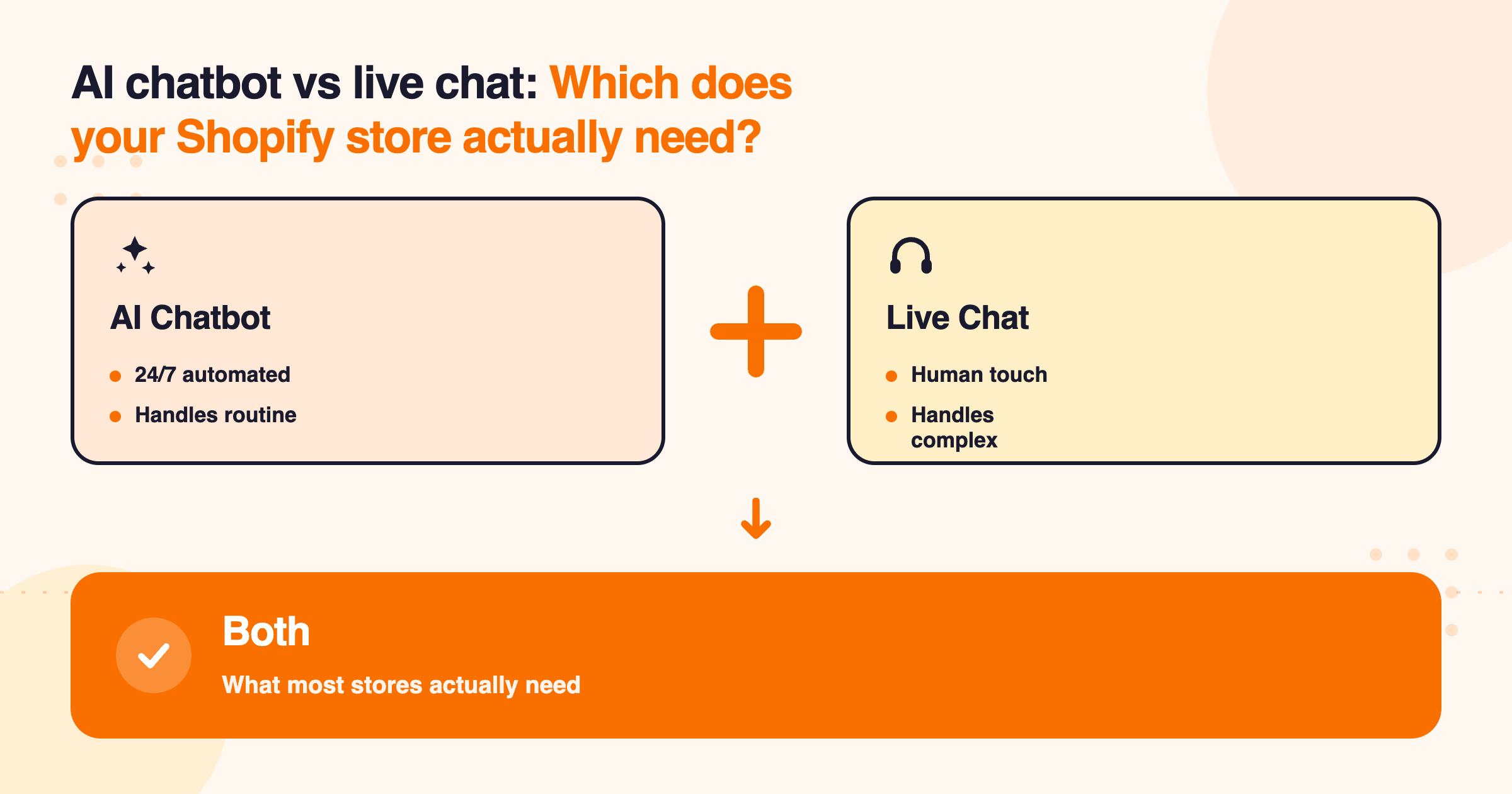
Table of contents
For most Shopify merchants, the question isn't AI chatbot vs live chat. It's which one to prioritise first, and how to run both together without needing to hire a bigger team or buy two separate tools.
An AI chatbot responds to customers automatically, 24/7, without a human in the loop. Live chat connects customers to a real person in real time. Both have a role. For most Shopify stores, the right setup is a hybrid: AI handles the routine queries and live chat handles the complex ones. The question is where to start.
This guide covers the key differences, when to prioritise each tool, the real cost comparison (software plus staff), and a quick-pick recommendation by store type.
New to AI chatbots? Start here first: What Is an AI Chatbot?
What's the actual difference between AI chatbot and live chat?
Live chat is a real-time messaging channel where a human agent types responses to customers. It's better for complex situations, emotionally charged conversations, and high-consideration purchases where personal judgment matters. It requires someone to be available and actively monitoring the inbox.
An AI chatbot is software that reads customer messages, understands the intent through natural language processing (NLP), and responds automatically. It handles FAQs, order tracking, cart recovery, and product questions around the clock without a human agent. It doesn't need anyone to be online.
A quick note on terminology: a chatbox is simply the chat window that appears on your store. A chatbot is the AI software that operates inside it. Most merchants use both terms interchangeably, but technically they're different things.
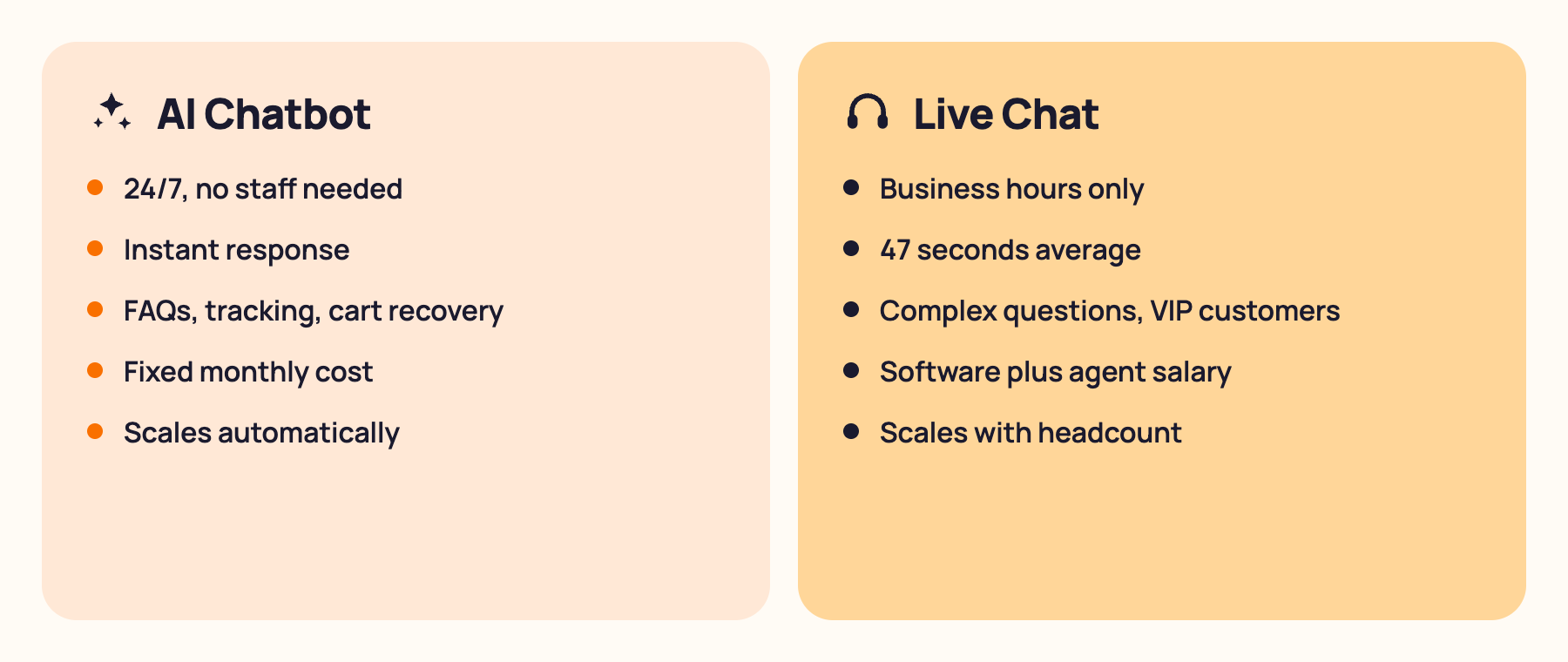
Here's how they compare on the dimensions that matter for Shopify stores:
| AI Chatbot | Live Chat | |
|---|---|---|
| Availability | 24/7, no staff needed | Business hours only (unless you hire overnight) |
| Response time | Instant | 47 seconds average (Tidio research) |
| Best for | FAQs, order tracking, returns, cart recovery | Complex questions, complaints, VIP customers |
| Cost | Fixed monthly subscription | Subscription plus agent salaries |
| Scales automatically | Yes | No (scales with headcount) |
| Human touch | Limited | Full |
These are different tools solving different problems. The goal isn't to choose one. It's to know which to implement first for your store's current situation.
When should you prioritise an AI chatbot?
Start with an AI chatbot if any of these describe your store.
You're getting more than 30 support queries per day and many are repetitive. If WISMO queries ("Where is my order?") are eating your team's time, chatbot automation is the highest-ROI fix available. According to eDesk's research on ecommerce support, WISMO accounts for 20-40% of all support tickets in a typical store, rising above 50% during BFCM and peak periods. Connecting a chatbot to Shopify's order data handles this entire category automatically from day one.
You sell internationally or to customers in multiple time zones. A customer in Australia browsing your UK store at 8 AM their time (10 PM yours) needs an answer now. An AI chatbot doesn't have office hours. Live chat without overnight staffing means international revenue quietly walking out the door.
You have a lean team of 1-3 people who can't staff live chat reliably. A chatbot that handles 60% of queries automatically is worth far more than a live chat widget that shows as offline for half the day. Customers who hit an offline status don't wait. They leave.
Your support volume spikes seasonally. During BFCM, support volume can triple or quadruple overnight. An AI chatbot scales to thousands of simultaneous conversations with no drop in quality and no need to hire seasonal staff.
Real Shopify scenario: A clothing store processing 800 orders per month gets roughly 120 support queries monthly. If 70% are order tracking and return policy questions, that's 84 tickets the chatbot handles automatically, roughly 7-8 hours of agent time returned every month from a single setup.
For the full ticket reduction framework, see: AI chatbot for customer support: How to cut support tickets by 50%
When should you prioritise live chat?
Live chat is the right starting point in specific situations where human judgment is genuinely irreplaceable.
You sell high-consideration products where expert guidance drives the conversion. Bespoke furniture, custom orders, luxury items, specialist equipment, or anything where a nuanced product conversation is the difference between a sale and a bounce. A knowledgeable person on live chat at the right moment outperforms any automation here.
Your customers expect and value personal interaction. Premium skincare brands, fine jewellery retailers, and specialist B2B Shopify stores often have customers who find chatbot responses impersonal. In those markets, live chat builds more trust and converts better.
Your support volume is genuinely low, under 20 queries per day, and your team can handle it. At very low volume, live chat is cheaper and simpler than setting up and training an AI chatbot. The automation payoff comes later when volume grows.
Most of your queries are complex and one-off. Unusual returns, bespoke order modifications, fraud disputes, high-value complaints. These require human judgment and are not good candidates for automation regardless of chatbot quality.
Real Shopify scenario: A made-to-measure suit retailer gets 40 queries per month, 70% of which are complex sizing and customisation questions that require back-and-forth with a knowledgeable team member. Chatbot automation would frustrate their customers. Live chat is the right primary tool, with a chatbot for after-hours FAQ coverage as a useful addition once the basics are running.
The real cost comparison
Most merchants compare software costs. The real comparison includes the human cost of live chat.
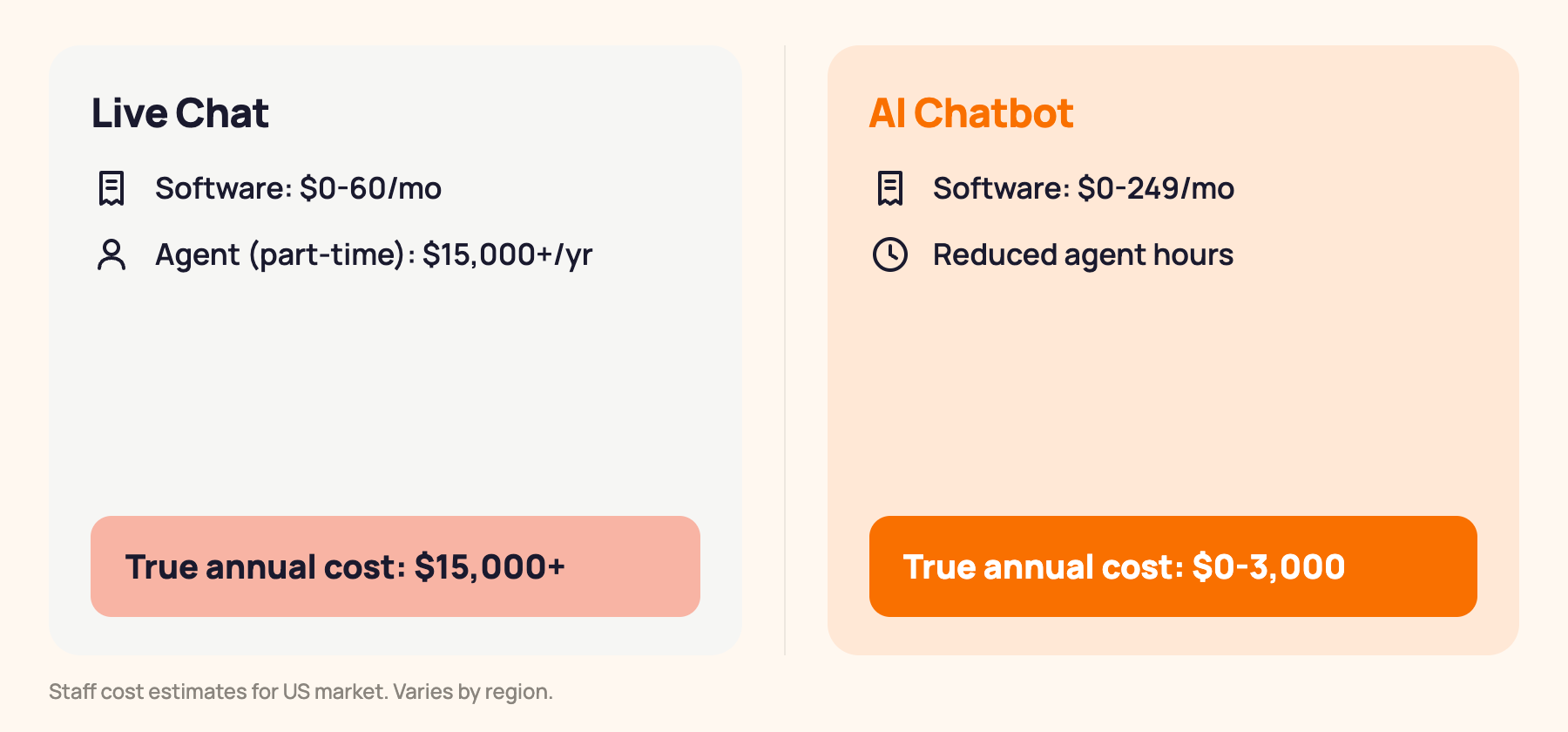
Live chat true cost:
- Software: $0-60/month (Shopify Inbox is free, most live chat tools start under $30/month)
- Agent cost: the average part-time customer service agent (20 hours/week) costs $15,000-20,000/year in the US. Even in lower-cost markets, real staffing cost is significant.
- Total at minimum viable staffing: $15,000+ per year just for the human layer
AI chatbot true cost:
- Software: $0-249/month for most Shopify-native tools (MooseDesk starts free with unlimited AI replies)
- Agent cost: one agent handling only complex escalations (20-30% of volume) rather than 100%. Fewer hours needed, or the same hours used on genuinely complex work
- Total: $0-3,000/year in software, significantly reduced agent hours
The practical conclusion: for stores doing meaningful support volume, AI chatbot automation typically pays for itself within the first month by reducing the agent hours needed for routine queries. Live chat is not free when you account for the human on the other end.
This is not an argument to replace staff. It's an argument that automation lets your existing team work on the queries that genuinely need them, rather than spending their day answering the same five questions on repeat.
Do you have to choose? The case for running both
The honest answer for most Shopify stores: you need both, running together. The question was never really "which one". It was "how do I run both without doubling my costs or my complexity?"
The hybrid model that works for most Shopify stores:
AI chatbot handles: FAQs, order tracking, return initiation, product questions, cart recovery, and all after-hours queries. Target: 60-70% of incoming volume handled automatically.
Live chat handles: Complex disputes, VIP customers, emotionally sensitive situations, and anything the chatbot correctly escalates. Target: 30-40% of volume, all of it genuinely needing a human.
The efficiency gain: your team stops spending time on "where is my order?" and starts spending it on conversations that actually need them. A store where the founder used to spend three hours a day on support can realistically get that to 30-40 minutes of high-value interaction once both tools are running correctly.
The practical barrier merchants worry about is cost. The good news: you don't need two separate subscriptions. Shopify-native apps like MooseDesk include AI chatbot, live chat, and helpdesk in one tool. One setup, one dashboard, one bill.
One thing worth sharing from our own experience: the team behind MooseDesk has been building Shopify solutions for over 10 years. MooseDesk itself launched in 2023, purpose-built specifically for the challenges we kept seeing Shopify merchants face with fragmented support tools. The pattern we see most consistently across stores using MooseDesk is this: merchants who configure WISMO automation as their very first flow see the fastest time-to-value, often within the first week of going live. It's the highest-volume, most automatable ticket type across nearly every store type we've worked with, regardless of niche or order volume. Starting there, before tackling FAQs or returns, gives you an immediate win that builds confidence in the setup and makes the case internally for expanding automation further.
For the full setup guide, see: How to add live chat and AI chatbot to your Shopify store
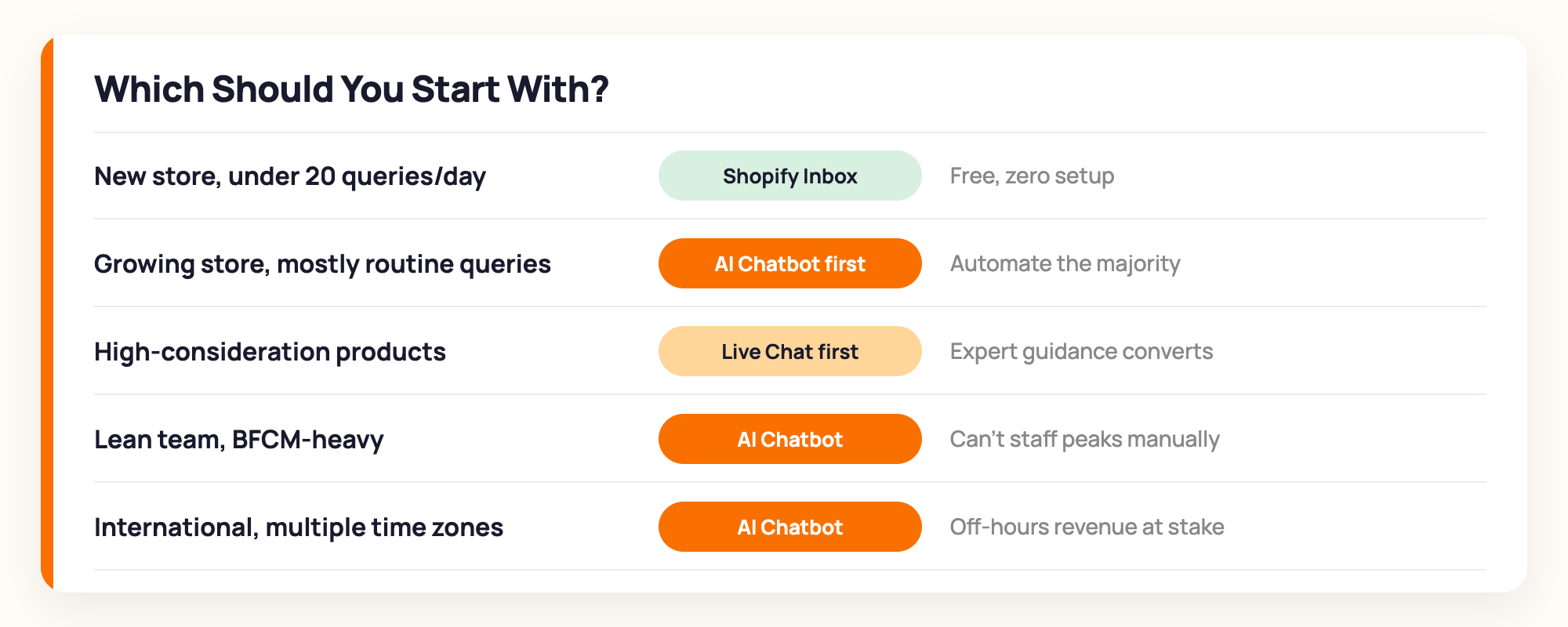
Quick-pick guide by store type
Not sure which to start with? Here's the answer for five common Shopify store profiles.
New store, under 20 queries per day: Start with Shopify Inbox (free, built-in, zero setup). Add an AI chatbot when volume grows past 20 queries per day or when you're fielding the same questions repeatedly.
Growing store, 20-100 queries per day, mostly routine: Prioritise AI chatbot first. Get WISMO and FAQ automation running. Add live chat for escalations. This is the most common profile for merchants who should start with automation.
High-consideration product store (luxury, bespoke, custom): Start with live chat. Your customers need expert guidance. Add a chatbot for after-hours FAQ coverage and basic order tracking once live chat is established.
Lean team, high volume, BFCM-heavy: AI chatbot is non-negotiable. You physically cannot staff live chat during peak season at scale. Automate the routine, use live chat only for escalations. The chatbot earns its cost most visibly during these periods.
International store with multiple time zones: AI chatbot is essential. Live chat alone loses revenue during the hours no one is online. An AI chatbot capturing those off-hours conversions is one of the clearest direct revenue arguments for the technology.
Not sure which tools to compare? See the full breakdown: Best AI chatbot apps for Shopify
Frequently asked questions about AI chatbot vs live chat
What is the difference between live chat and a chatbot?
Live chat connects a customer to a human agent who reads and types responses in real time. A chatbot responds automatically using AI: it reads the customer's message, identifies the intent, and sends a reply without any human involvement. The core difference: live chat requires someone to be online and available; a chatbot works around the clock with no human needed. Most Shopify stores benefit from running both: the chatbot handles high-volume routine queries automatically and live chat handles the complex situations that need a person.
How much does live chat vs AI chatbot cost for a Shopify store?
AI chatbot software costs $0-249/month for most Shopify-native tools. Live chat software is similar in price ($0-60/month), but the real cost of live chat is the human agent. A part-time support agent working 20 hours per week adds $15,000-20,000 per year in staff cost. For stores with meaningful support volume, AI chatbot automation typically pays for itself by reducing the agent hours needed for routine queries.
Do I need both live chat and an AI chatbot?
For most Shopify stores handling more than 20 support queries per day, yes. The AI chatbot handles the repeatable majority (FAQs, order tracking, cart recovery) and live chat handles the complex minority: disputes, VIP customers, nuanced questions. Several Shopify apps combine both in one tool, so you don't need two separate subscriptions to run the hybrid setup.
What about Shopify Inbox: is that a chatbot or live chat?
Shopify Inbox is primarily a live chat tool. It uses Shopify Magic AI to suggest replies, but it still requires a human to send them. It's not an autonomous AI chatbot. It's a solid free starting point for new or very low-volume stores, but it doesn't automate conversations the way a trained AI chatbot does. Once your store grows past 20-30 queries per day, you'll likely outgrow Shopify Inbox and want a tool with genuine AI automation.
What are the four types of chatbots?
The four main types are: rule-based chatbots (follow fixed decision trees), AI-powered chatbots (understand natural language and learn over time), hybrid chatbots (combine both approaches), and voice chatbots (handle spoken rather than typed conversations). For Shopify merchants, the relevant distinction is between rule-based, AI-powered, and hybrid. For a full breakdown of each type and which fits your store, see: What Is an AI Chatbot?
For a full breakdown of each chatbot type and which fits your store, see: What Is an AI Chatbot?
The chatbot vs live chat debate is largely a false choice. Most Shopify stores need both, the question is just where to start. Use the quick-pick guide above to identify your starting point, then add the second layer once the first is running well.
For the complete picture on AI chatbots for Shopify, see our complete guide to AI chatbots for ecommerce.
MooseDesk gives you both: an AI chatbot for routine queries and live chat for the complex ones, in one Shopify-native app. No need to choose.
Try MooseDesk
AI chatbot, live chat, and helpdesk in one Shopify-native app.
Free plan available. 1-min setup. 24/7 Support.