AI chatbot for ecommerce: The complete guide to automating support and driving sales (2026)
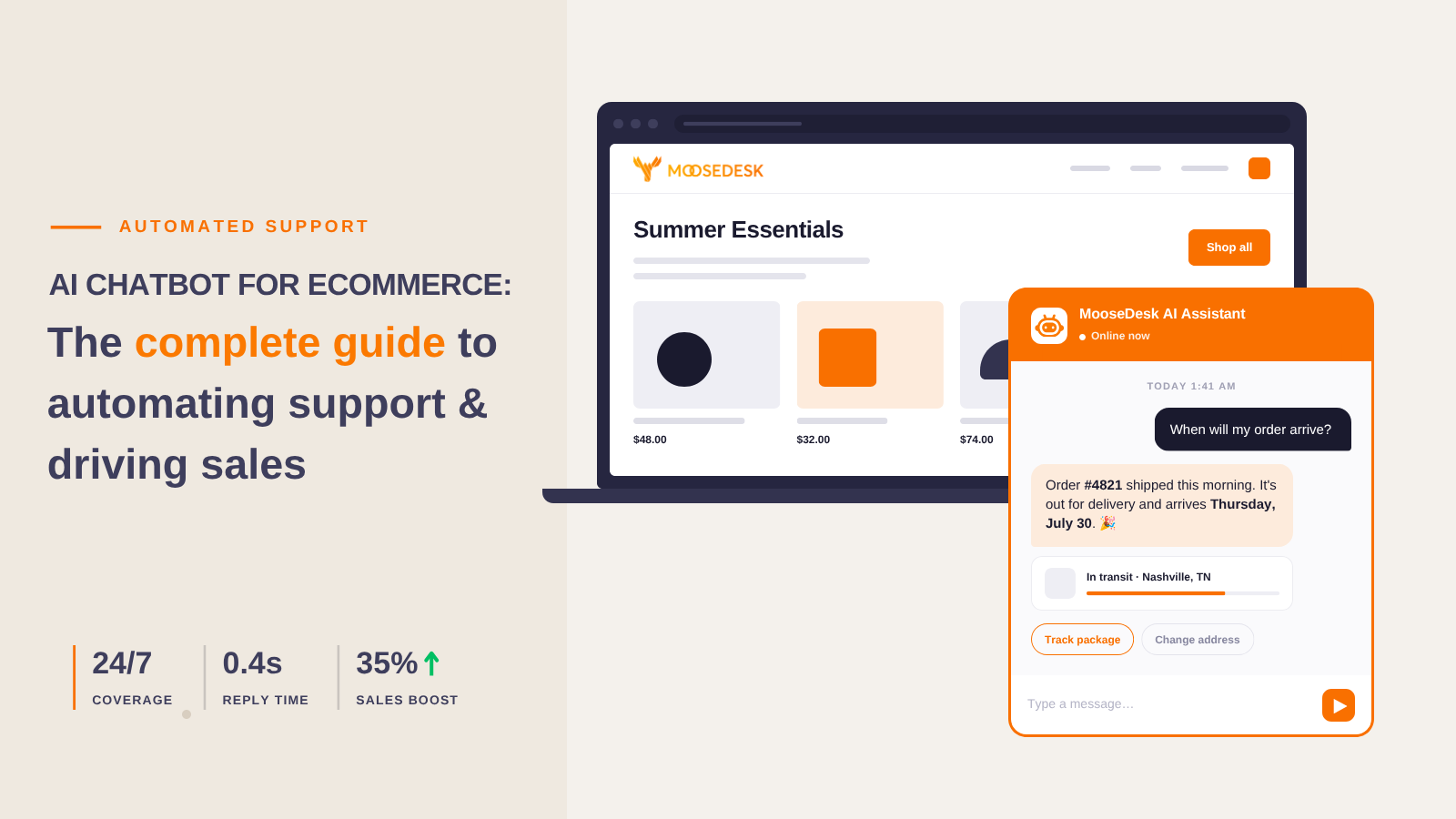
Table of contents
- What is an AI chatbot for ecommerce?
- What can an AI chatbot do for your Shopify store?
- Why do AI chatbots improve ecommerce business results?
- Types of ecommerce AI chatbots (and which fits your store)
- How to choose an AI chatbot for your Shopify store
- How to add an AI chatbot to your Shopify store
- Frequently asked questions
An AI chatbot for ecommerce is software that automatically handles customer conversations on your Shopify store: answering questions, recommending products, recovering abandoned carts, and tracking orders, around the clock without a human agent. In plain terms, it's the always-on support rep your store has needed but couldn't afford to hire.
This guide covers what ecommerce AI chatbots actually do, which type fits your store's stage, how to choose one, and how to get it live. The examples and recommendations are written specifically for Shopify merchants, though the core principles apply to any ecommerce platform. By the end, you'll have a clear picture of whether this is the right investment for your store right now.
What is an AI chatbot for ecommerce?
An ecommerce AI chatbot is a conversational tool trained on your store's specific data (your products, pricing, shipping policies, and FAQs) so it can respond to customer questions instantly and accurately, even at 3 AM on a Sunday.
Unlike a basic live chat widget (which just waits for a human agent to respond), a modern AI chatbot understands what customers mean, not just what they type. This is possible because of natural language processing (NLP), a technology that interprets the intent behind a message rather than matching exact words. "Where's my stuff?" and "I haven't received my order yet" both trigger the same order tracking response, because the bot reads intent rather than keywords.
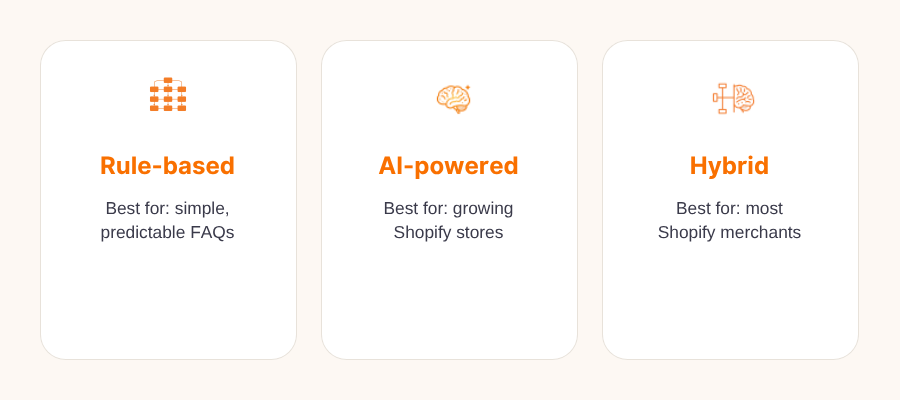
There are three main types of ecommerce chatbots:
- Rule-based chatbots follow a fixed decision tree. Customers click buttons and select options. Reliable for highly predictable FAQs, but the moment a customer goes off-script, the bot hits a wall.
- AI-powered chatbots use machine learning and NLP to handle open-ended questions, learn from conversations over time, and generate context-aware responses. These are the standard for most growing Shopify stores.
- Hybrid chatbots combine both approaches. AI handles free-text questions; structured flows handle defined processes like returns or order status lookups. This is the most practical setup for most Shopify merchants.
According to research by eTail, over 85% of retail and ecommerce businesses have now implemented some form of chatbot. The gap between stores using AI support and those without is widening fast.
What can an AI chatbot do for your Shopify store?
AI chatbots work across the entire customer journey, from the moment a visitor lands on your store to long after they've placed an order. Here's where they move the needle most.

Does an AI chatbot really work for customer support?
Yes, and availability is the most immediate proof. Your support team can't be online at 3 AM on a Sunday. An AI chatbot can.
A shopper browsing your store late at night might ask about your return policy, whether a product ships internationally, or how long a custom order takes. The chatbot pulls from your knowledge base and responds in seconds: no wait time, no ticket opened, no email chain started.
This removes friction at the exact moment a customer is deciding whether to buy. A question answered quickly is a sale that doesn't slip away. That's not a soft benefit. It directly affects your conversion rate.
Recover abandoned carts
Cart abandonment sits at around 70% across ecommerce, according to data compiled by the Baymard Institute. That means roughly 7 out of 10 shoppers who add something to their cart leave without buying. Most weren't disinterested. They got distracted, had an unanswered question, or hesitated at checkout.
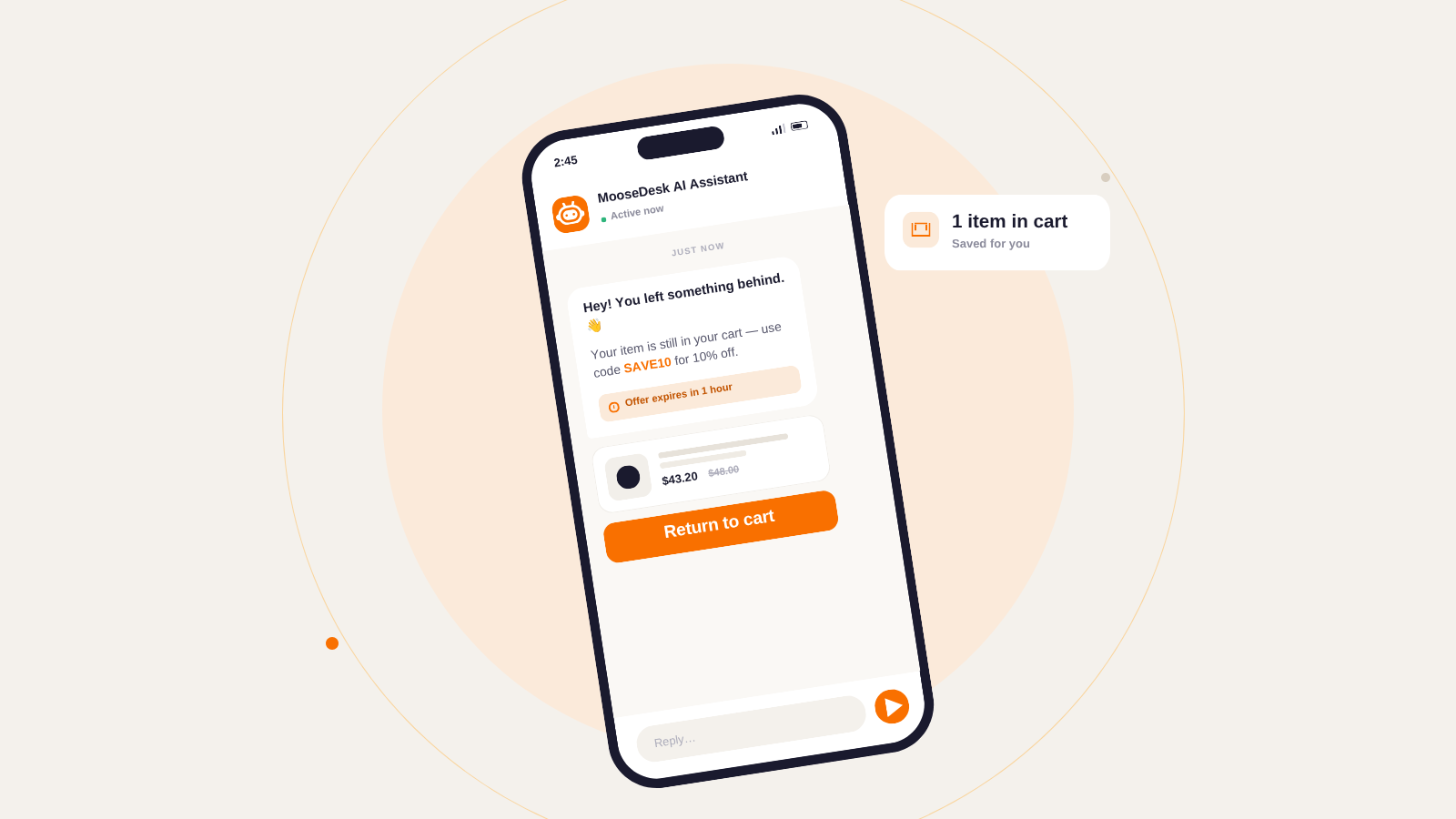
AI chatbots close that gap. When a shopper lingers on the checkout page or navigates away mid-purchase, the bot can trigger a proactive message: "Still thinking it over? Here's 10% off if you complete your order in the next hour." On WhatsApp or Facebook Messenger, it can follow up hours later with a personalised nudge.
These aren't spam messages. They're well-timed prompts for customers who were already close to buying.
Make product recommendations
Think of the AI chatbot as your store's always-on sales assistant. A shopper types "I'm looking for a gift for my mum under $50" and the bot asks two clarifying questions, then surfaces three relevant products with links and short descriptions.
This is the ecommerce AI shopping assistant use case: software that guides customers to the right product through conversation, the way a good in-store staff member would. It scales to hundreds of simultaneous conversations without adding a single person to your payroll.
Upsell and cross-sell flows fit naturally here too. A customer buying a camera gets offered a compatible lens. A shopper adding one pair of socks learns they qualify for a bundle discount at three pairs.
Handle order tracking and post-purchase support
"Where is my order?" is the single most common customer service query in ecommerce. It's also completely automatable.
Once your chatbot connects to Shopify's order management system, it pulls real-time tracking data and delivers an instant update the moment a customer asks. No human agent required.
Returns work the same way. Instead of a customer hunting through your store for a returns policy and emailing to initiate the process, the chatbot walks them through it step by step: eligibility check, return label generation, confirmation. Your team gets one less ticket. Your customer gets an answer in under a minute.
Capture sales from international customers
International visitors browse your store while your team is offline. For Shopify merchants selling globally, time zones are a genuine revenue problem. An AI chatbot doesn't have office hours.
A customer in Sydney shopping your US-based store at 8 AM their time (10 PM yours) gets the same instant, helpful experience as someone shopping at noon. This is one of the most overlooked ways an AI chatbot adds revenue without adding headcount.
Why do AI chatbots improve ecommerce business results?
The case for customer service automation goes beyond convenience. Four outcomes have measurable impact on your bottom line.
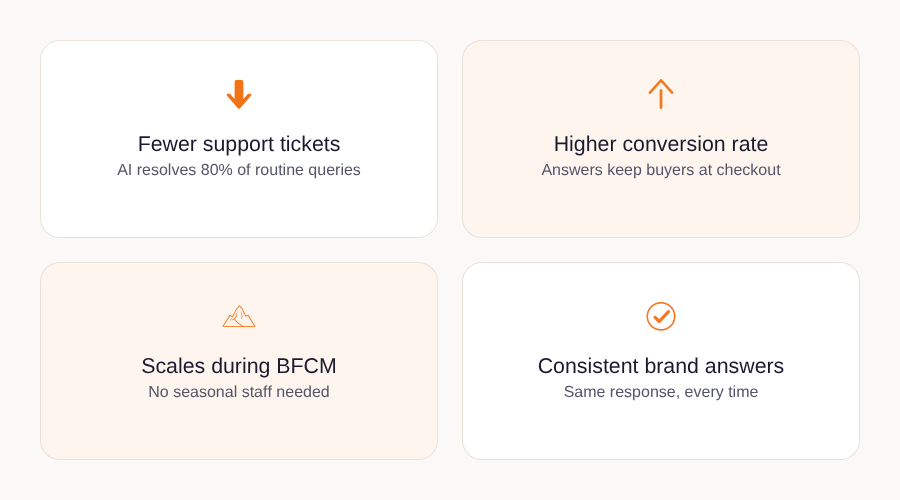
Fewer support tickets. When your chatbot handles FAQs, order tracking, and return queries automatically, your human agents deal with a fraction of their previous volume. Gartner research projects that by 2029, AI will autonomously resolve 80% of common customer service issues without human involvement. Many Shopify stores are already seeing significant ticket reduction today.
Higher conversion rates. Chatbots reduce friction at exactly the moments when buyers hesitate. A question answered at checkout keeps the purchase moving forward. A proactive message on a high-exit product page can turn an abandonment into a sale.
Scalability during BFCM and peak season. Black Friday and Cyber Monday (BFCM) is the period when support queues overflow and response times balloon. An AI chatbot scales instantly to handle thousands of simultaneous conversations with no drop in quality. You don't hire seasonal staff. Queries don't pile up unanswered.
Consistent, on-brand answers. Human agents have good days and bad days. They phrase things differently. They occasionally misremember a policy detail. A well-trained chatbot gives the same accurate, on-brand answer every time, which builds the kind of steady trust that brings customers back.
Types of ecommerce AI chatbots (and which fits your store)
Not all chatbots are built the same. Choosing the wrong type for your store's current stage means either missing capabilities you need or paying for complexity you don't. Here's how to think about it.
Rule-based chatbots are the simplest option and work well when your customer queries are highly predictable. If 90% of your questions are "What's your return policy?" and "Do you ship to Canada?", a rule-based bot handles those cleanly and cheaply. The limitation: the moment a customer asks something outside the pre-set script, the bot fails.
AI-powered chatbots (NLP-based) are the right choice for most growing Shopify stores. They understand natural language, handle variations in phrasing, and improve as they process more conversations. Edge cases still need human escalation, but they handle the long tail of customer queries that rule-based bots simply can't.
Hybrid chatbots are the practical sweet spot for merchants scaling their support. Structured flows handle predictable processes (start a return, check order status, apply a discount code) while AI handles open-ended questions. This gives you automation where it matters and flexibility where you need it.
All-in-one support apps go a step further by combining chatbot, live chat, and helpdesk in a single platform. Rather than stitching together three separate tools, one app handles everything. MooseDesk is built on this model (AI chatbot, live chat, and helpdesk in one Shopify-native app), so your support conversations, ticket history, and automations all live in the same place. A note on where this came from: Vegahub's team has spent over a decade building tools for Shopify merchants, and MooseDesk launched in 2023 as the product that came directly out of that experience. The all-in-one model wasn't a product decision made in a boardroom. It came from watching merchants juggle three separate dashboards, lose conversation history in handoffs, and miss tickets because data wasn't syncing between tools. Consolidating chatbot, helpdesk, and live chat wasn't a feature list choice: it was the only architecture that actually solved the problem we kept seeing.
For most Shopify merchants, a hybrid chatbot connected to a helpdesk is the most practical starting point. You get automation for routine queries and a clean escalation path when conversations get complex.
How to choose an AI chatbot for your Shopify store
With dozens of options available, the decision comes down to fit rather than a feature checklist. Here's what actually matters.
Shopify integration. Your chatbot needs to install directly from the Shopify App Store and connect natively to your orders, customers, and inventory data. A chatbot that can't pull real-time order information is limited in what it can automate. Check it also works with the rest of your stack: helpdesk, email marketing, CRM.
AI quality. Ask the vendor directly: does the bot understand natural language, or does it just match keywords? Can you train it on your specific product catalog and FAQ content? A bot trained on your store data will significantly outperform a generic one within the first week of use.
Support and sales balance. Most chatbot tools lean one direction: either pure support automation or pure lead generation. For Shopify merchants, you need both: a bot that handles order queries and makes product recommendations and recovers carts. Test against your most common support scenarios and your most common sales scenarios before committing.
Pricing model. Some tools charge per conversation, others per seat, per resolution, or a flat monthly fee. A store handling 200 support queries a month and a store handling 5,000 have completely different cost profiles. Run the numbers before you sign up.
Ease of setup. If you don't have a developer on your team, no-code setup is non-negotiable. Most quality chatbot apps now offer visual builders and pre-built templates. You shouldn't need to write a line of code to go live.
Human handoff. Human handoff is the process where a chatbot transfers a conversation to a live agent when it can't resolve the issue. The best chatbots do this automatically when a customer is angry, asks something complex, or explicitly requests a person. The bot passes the full conversation history so the customer doesn't have to repeat themselves.
One practical tip: use the free trial. Write down your 10 most common customer questions before you start, and test the bot against all of them on day one. If it handles 8 or more accurately, you have a solid foundation.
How to add an AI chatbot to your Shopify store
Getting a chatbot live is simpler than most merchants expect. Here's the short version. For the full walkthrough, see our step-by-step guide: How to add an AI chatbot to your Shopify store.
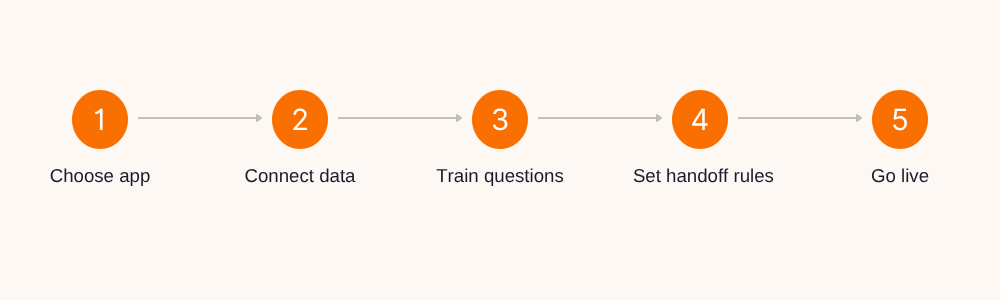
- Choose your app. Search "AI chatbot" or "helpdesk" in the Shopify App Store. Filter by rating and review count. Look for apps that specifically mention Shopify order integration.
- Install and connect your store data. Link the app to your product catalog, order management system, and any existing FAQ content. The more store-specific data you load upfront, the better the bot performs from day one.
- Train on your top questions. List your 10 to 15 most common customer questions and make sure the bot has accurate, on-brand answers for all of them. This step gets rushed most often and causes the most problems post-launch.
- Set up human handoff rules. Define the trigger phrases that should escalate a conversation, such as "complaint", "broken", or "refund not received", or an explicit request for a person.
- Go live and monitor daily for two weeks. Check your chat logs every day. Questions the bot handled poorly become your training priorities for the following week.
Most Shopify merchants reach a solid baseline within two to three weeks of launch. The learning curve is real, but it's short.
Frequently asked questions
What is an AI chatbot for ecommerce?
An AI chatbot for ecommerce is software that automatically handles customer conversations on an online store, covering support questions, product recommendations, abandoned cart recovery, and order status requests, without a human agent. It runs 24/7 and is trained on the store's specific products, policies, and FAQs.
What is the best AI chatbot for ecommerce?
The best option depends on your store's size and support volume. For Shopify merchants, prioritise native Shopify integration, NLP-based AI (not just keyword matching), and a tool that handles both customer service and sales flows. MooseDesk combines AI chatbot, live chat, and helpdesk in one Shopify-native app. See how it compares in our full Shopify chatbot comparison.
How does an AI chatbot increase ecommerce sales?
Four mechanisms drive sales lift: product recommendations that guide undecided shoppers to the right purchase; cart recovery messages that bring back shoppers who left mid-checkout; 24/7 availability that captures sales from international and late-night visitors; and faster answers at checkout that reduce drop-off at the final decision moment.
Can an AI chatbot replace human customer service?
No. AI chatbots handle routine, high-volume queries well: FAQs, order tracking, return initiation, and shipping questions. But complex situations, emotionally charged complaints, and anything requiring judgment or empathy still need a human agent. The practical goal is for the bot to handle 60 to 80% of incoming queries so your team can focus on the conversations that genuinely require them.
Is there a free AI chatbot for ecommerce stores?
Yes. Several Shopify chatbot apps offer free plans with limited conversation volume or features. Free tiers are a reasonable way to test a platform before committing, but most stores with meaningful support volume outgrow them within a few months. For a breakdown of free and paid options, see our Shopify chatbot pricing comparison.
How long does it take to set up an AI chatbot on Shopify?
Most Shopify merchants can get an AI chatbot live within one to two days of installing the app. The setup itself (connecting store data, training on your top questions, and configuring human handoff rules) typically takes two to four hours. Reaching a fully optimised baseline, where the bot handles most queries accurately, takes two to three weeks of monitoring and refinement.
Supporting customers well is one of the hardest operational challenges in ecommerce. An AI chatbot won't replace your team, but it will absorb the high-volume routine queries they currently spend most of their time on, freeing them for the work that actually needs a human touch.
Try MooseDesk
AI chatbot, live chat, and helpdesk in one Shopify-native app.
Free plan available. 1-min setup. 24/7 Support.