What is an AI Chatbot? How it works for ecommerce stores
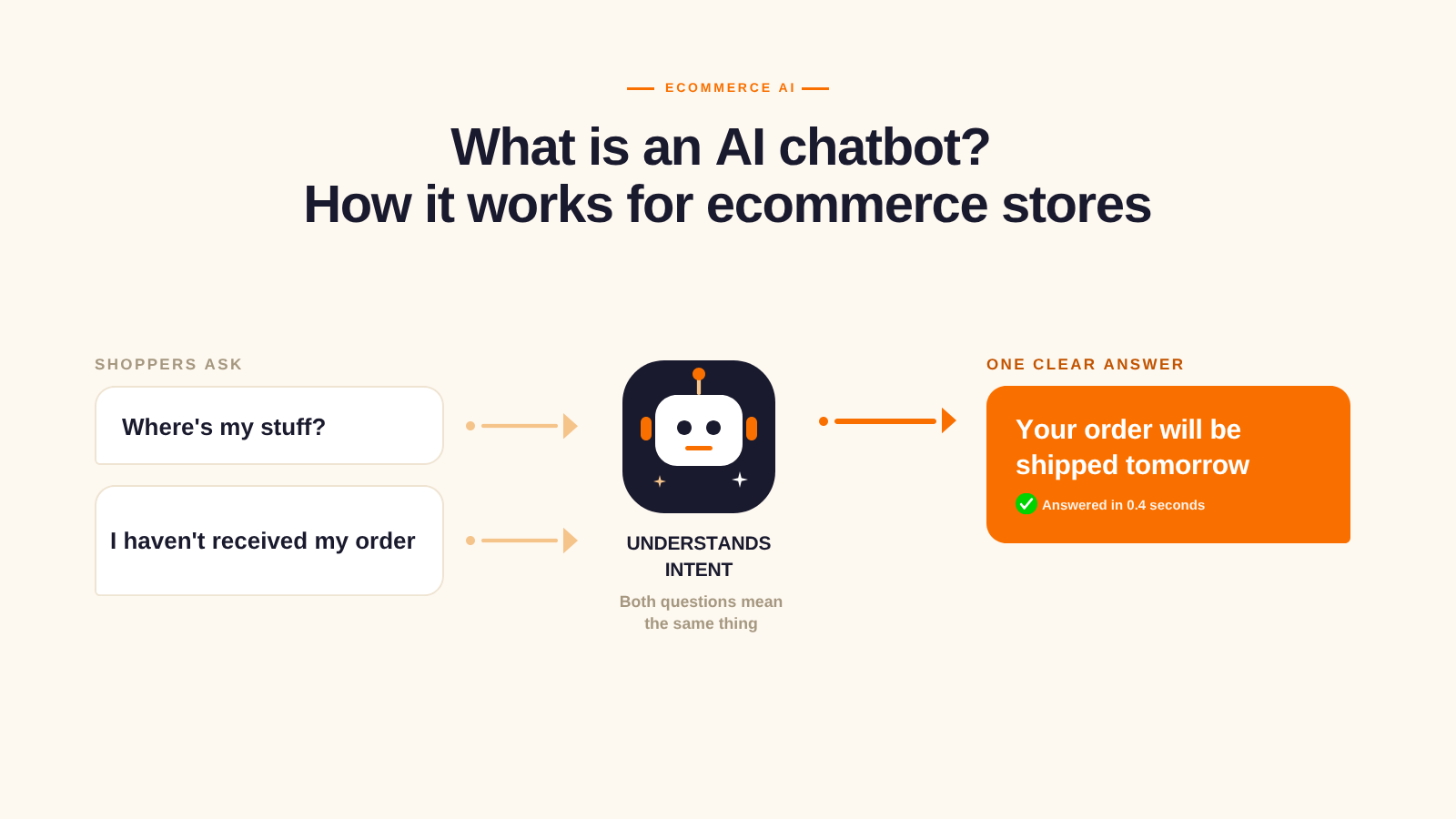
Table of contents
An AI chatbot is software that understands what your customers type, in their own words, and replies instantly without a human agent. It's not a chat widget sitting idle until someone on your team notices a notification. It reads the message, figures out what the customer actually needs, and responds, at 2 PM or 2 AM.
If you've heard the term but weren't quite sure how it differs from a basic chat popup, or whether it's actually worth having on your Shopify store, this is the article for you. We'll cover what an AI chatbot is, how it works in plain English, the three types available, and what it does for ecommerce stores specifically.
For a deeper look at the full picture, including setup steps and a comparison of the best tools, see our complete guide to AI chatbots for ecommerce.
What is an AI Chatbot?
An AI chatbot is a software program that uses artificial intelligence to understand customer messages and reply automatically, in natural language, without a human typing each response.
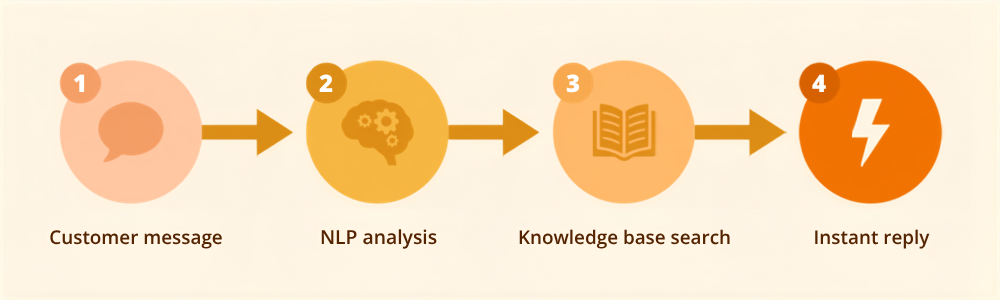
That last part is what separates it from a live chat widget. A standard live chat widget requires someone on your team to be online and actively responding. An AI chatbot doesn't wait for anyone. It reads the incoming message, identifies what the customer is asking, and sends a relevant answer in seconds, regardless of the time.
It's also different from an older-style rule-based bot, which only responds to exact keywords or pre-set menu clicks. If a customer types something the bot wasn't specifically programmed for, a rule-based bot fails. An AI chatbot understands intent. "My package is late," "where's my order," and "I haven't received anything yet" all mean the same thing to it, and it responds accordingly.
According to Salesforce, 91% of small and medium businesses say AI boosts their revenue. For Shopify merchants, the most direct path to that boost is the customer-facing layer: the moment a shopper has a question and either gets an instant answer or doesn't.
How does an AI chatbot work?
An AI chatbot processes customer messages using a technology called natural language processing (NLP), which is the ability to understand human language as it's actually written or spoken, not just as a set of keywords to match.
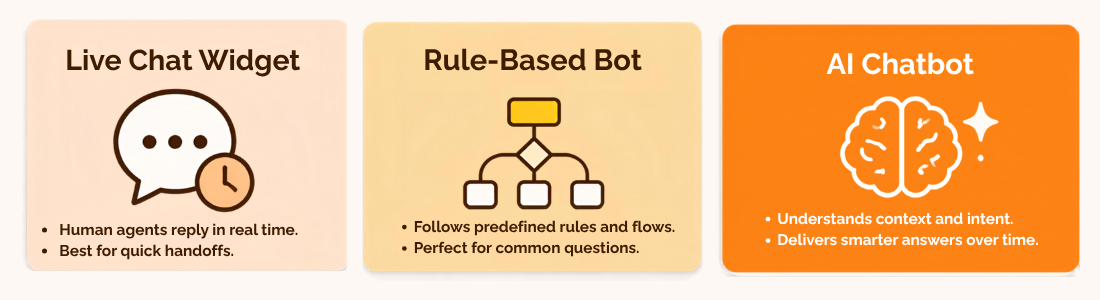
Here's what happens in the background every time a customer sends a message:
- The customer types a message. ("Is this jacket waterproof?")
- NLP analyses the words and identifies the intent. (Product question, specific attribute: waterproofing)
- The bot searches your knowledge base, product data, or FAQs for the relevant answer.
- It generates a natural-language reply and sends it instantly. ("Yes, this jacket has a DWR water-resistant coating. It handles light rain well but isn't designed for heavy downpours. Want me to share the full product specs?")
The more conversations the bot handles, the better it gets. This is machine learning at work: the system learns from past interactions and continuously improves how it handles your store's specific questions.
The most advanced AI chatbots are powered by large language models (LLMs), which are AI systems trained on vast amounts of human language data. LLMs are the same technology behind tools like ChatGPT. For ecommerce, this means the bot can handle nuanced, multi-step questions naturally, rather than failing the moment a customer phrases something in an unexpected way.
What are the types of AI chatbots?
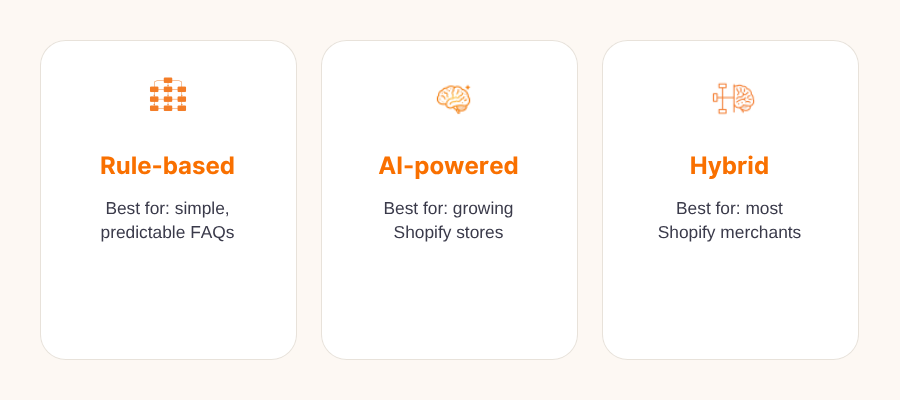
Not every chatbot uses AI. And among those that do, the implementation varies quite a bit. Here are the three types you'll actually encounter when shopping for a tool for your Shopify store.
Rule-based chatbots
Rule-based chatbots follow a fixed decision tree. Customers click buttons or select from menus rather than typing freely. The bot maps each input to a pre-written response, and that's it.
They're cheap, predictable, and easy to set up. They also break the moment a customer types something the script didn't anticipate. For a store with fewer than five common customer queries, this can work. For anything more complex, it creates friction rather than resolving it.
AI-powered chatbots
AI-powered chatbots use NLP and machine learning to understand free-text questions and generate contextually relevant answers. They handle the variety of real customer conversations: misspellings, unusual phrasing, follow-up questions, and requests the bot has never seen before.
This is the type most growing Shopify stores should use. The setup requires more upfront work (training the bot on your product catalog, policies, and FAQs) but the payoff is a chatbot that actually handles the real volume of incoming questions without constant manual intervention.
Hybrid chatbots
Hybrid chatbots combine both approaches. Structured flows handle defined, repeatable processes (initiate a return, check order status, apply a discount code) while AI handles everything else. This is the most practical setup for most Shopify merchants.
You get the reliability of scripted flows for the tasks that need to be handled exactly right every time, plus the flexibility of AI for the unpredictable questions that make up the bulk of customer conversations. For a clothing store doing 300 orders a month, for example, this means returns and tracking happen on autopilot while product and sizing questions get handled intelligently.
An enterprise AI chatbot solution for ecommerce often defaults to this hybrid model precisely because it combines accuracy on routine tasks with flexibility on everything else.
What does an AI chatbot do for ecommerce stores?
Knowing what an AI chatbot is and knowing what it does for your store are two different things. Here's where the technology translates into outcomes a Shopify merchant actually cares about.
Answers customer questions around the clock
The most immediate use case is availability. Your support team has hours. Your customers don't shop on a schedule. An AI chatbot answers questions about shipping times, return policies, product specs, and sizing at any hour: instantly, no ticket opened, no email thread started.
A shopper browsing a skincare store at 11 PM asks whether a moisturiser is safe for sensitive skin. Without a chatbot, they leave or send an email that gets answered the next morning, long after they've bought from a competitor. With one, they get an answer in seconds and check out.
Recovers abandoned carts
Cart abandonment sits at around 70% across ecommerce, according to data from the Baymard Institute. That means 7 out of 10 shoppers who add something to their cart leave without buying. Most of them weren't disinterested. They got distracted, had a question, or hesitated at checkout.
A conversational AI chatbot for ecommerce can trigger a proactive message when a shopper lingers on the checkout page or navigates away. "Still thinking it over? This item tends to sell out quickly, and here's 10% off if you complete your order today." It's a well-timed nudge for a customer who was already close to buying.
Recommends products
An ecommerce AI shopping assistant doesn't wait for customers to ask. It guides them. A shopper types "I'm looking for a gift for my dad, budget around $60" and the chatbot asks two clarifying questions, then surfaces three relevant products with links.
This is upselling and cross-selling at a scale no human team can match. A customer buying a coffee grinder gets offered compatible filters. A shopper buying a yoga mat gets suggested a matching strap and block.
Handles order tracking automatically
"Where is my order?" is the most common customer service query in ecommerce. It's also the easiest to automate. Once your chatbot integrates with Shopify's order management system, it pulls real-time tracking data and answers the question instantly: no agent, no ticket, no delay.
The same applies to returns. Instead of a customer searching for your returns policy and sending an email to start the process, the chatbot walks them through every step automatically.
Scales without hiring
During BFCM, support volume can spike by 300% or more overnight. An AI chatbot handles that surge without slowing down, without errors, and without you needing to hire seasonal staff. For a lean Shopify store where the founder is also the support team, this is one of the highest-value upgrades available.
Gartner projects that by 2029, AI will autonomously resolve 80% of common customer service issues without human involvement. Many stores are already well ahead of that number today.
How do you add an AI chatbot to your Shopify store?
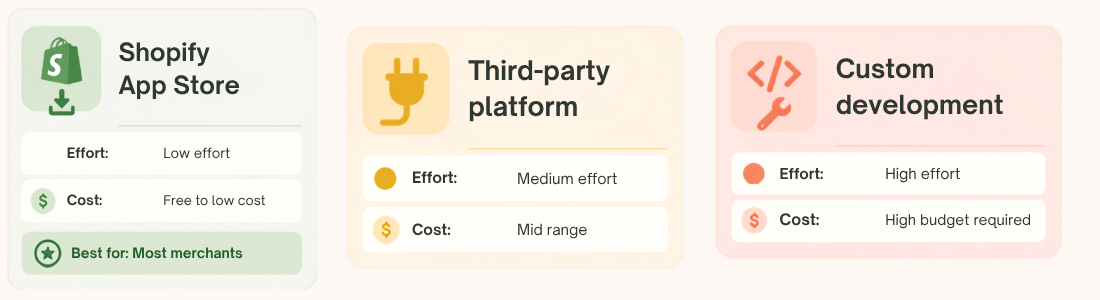
There are three paths, at different levels of effort and cost.
Install a Shopify App Store app. This is the right choice for most merchants. No code required, setup takes a few hours, and you're live the same day. Apps like MooseDesk install directly from the Shopify App Store and connect natively to your orders, products, and customer data. We've been building on Shopify for over 10 years, and MooseDesk launched in 2023, built directly on that experience. The install-and-connect model wasn't something we arrived at quickly. Early versions of Shopify chatbot integrations required merchants to manually export product data and upload it to a separate system, a process that broke constantly and produced outdated answers. Native API access changed everything. When the chatbot is reading live Shopify data rather than a snapshot, the accuracy difference is immediately visible in the first week of conversations.
Use a third-party chatbot platform with a Shopify integration. Slightly more configuration but more customisation options. Worth considering if you have specific requirements that go beyond what a Shopify-native app covers.
Custom AI chatbot development. Maximum control, built to your exact specification, but requires a developer, a budget, and months of build time. Custom AI chatbot development services exist for this path, but it's overkill for most Shopify stores at any stage.
For 95% of Shopify merchants, a Shopify-native app is the right starting point. You get meaningful automation running within a day, and you can always move to a more complex setup later if your needs grow.
For the full step-by-step setup process, see our guide: How to Add an AI Chatbot to Your Shopify Store.
Frequently Asked Questions about AI chatbots
What is an example of an AI chatbot?
Well-known general examples include Siri (Apple), Alexa (Amazon), and Google Assistant. For ecommerce specifically, AI chatbots are built into tools like MooseDesk, which handles customer support questions, order tracking, cart recovery, and product recommendations directly on Shopify stores. These are purpose-built for merchant use cases rather than general-purpose queries.
What does an AI chatbot do?
An AI chatbot handles customer conversations automatically, answering questions, providing order updates, recommending products, and recovering abandoned carts, without a human agent. It works 24/7, is trained on your store's specific data, and improves over time as it processes more conversations.
Is Siri a chatbot or AI?
Siri is both. It is a voice-based AI assistant that uses chatbot-style conversational interfaces. However, Siri is a general-purpose virtual assistant designed for personal use, while ecommerce AI chatbots are purpose-built for customer service: they're trained on product catalogs, order data, and store-specific FAQs rather than general knowledge.
Is Alexa a chatbot?
Alexa is a voice assistant that shares some characteristics with AI chatbots, but it is designed primarily for smart home control and general queries. Ecommerce AI chatbots are a separate category entirely, built to handle store-specific tasks like order tracking, return initiation, and product recommendations.
Is there a free AI chatbot for ecommerce?
Yes. Several Shopify chatbot apps offer free plans with limited conversation volume or features. They're a reasonable way to test a platform before committing. Most stores with meaningful support volume will outgrow them within a few months. For a breakdown of free and paid options, see our Shopify chatbot pricing comparison.
What is the best AI chatbot for ecommerce?
The best option depends on your store's size and support volume. For Shopify merchants, the key criteria are native Shopify integration, NLP-based AI (not just keyword matching), and the ability to handle both customer service and sales flows in one tool. See our full comparison of the best AI chatbot apps for Shopify.
AI chatbots aren't a future technology for large retailers with development budgets. They're available today, installable in an afternoon, and immediately useful for any Shopify store fielding more customer questions than the team can handle comfortably.
The clearest starting point is understanding what the technology actually does, and now you have it. The next step is deciding whether to install one.
If you want an AI chatbot built specifically for Shopify, one that combines AI chat, live chat, and helpdesk in one app, MooseDesk is worth trying.
Try MooseDesk
AI chatbot, live chat, and helpdesk in one Shopify-native app.
Free plan available. 1-min setup. 24/7 Support.