
How AI chatbots drive sales for Shopify stores (With real examples)
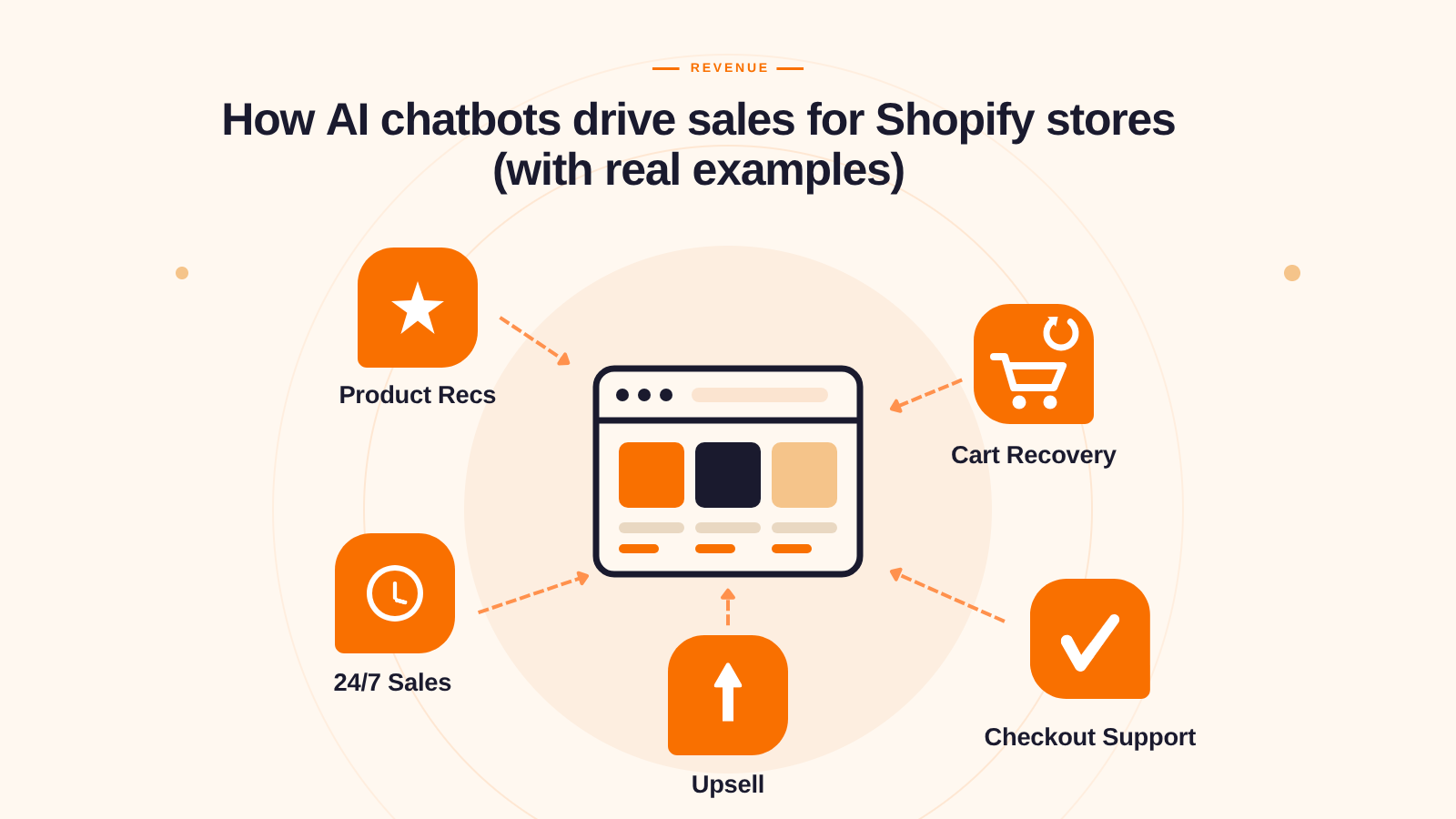
Table of contents
- Product recommendations: Your store's 24/7 sales assistant
- Cart abandonment recovery: Catching sales before they leave
- 24/7 sales capture: Selling while you sleep
- Real-time checkout support: Removing the last barrier
- Upsell and cross-sell: Revenue from every conversation
- What to measure: The numbers that confirm it's working
- Frequently Asked Questions about AI chatbots and ecommerce sales
Most Shopify merchants think of AI chatbots as a support cost-saver. That undersells them by half. AI chatbots for ecommerce drive sales through five specific mechanisms: product recommendations that guide undecided shoppers, cart abandonment recovery that brings back shoppers who left mid-checkout, 24/7 availability that captures international and late-night sales, real-time checkout support that removes last-moment hesitation, and upsell and cross-sell suggestions that increase average order value. Each one has measurable revenue impact.
This article covers all five with concrete Shopify store scenarios and the numbers behind them. If you're new to AI chatbots and want to understand the technology first, start with: How AI Chatbots Work for Ecommerce Customer Support.
Product recommendations: Your store's 24/7 sales assistant
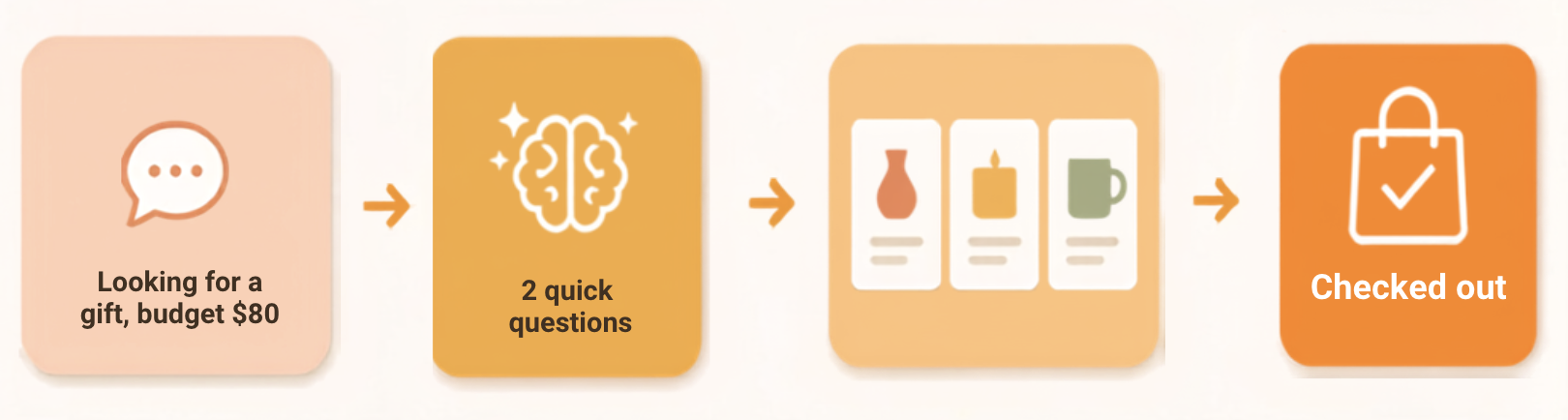
An AI chatbot acts as an ecommerce AI shopping assistant, asking one or two clarifying questions and surfacing the right product before a shopper gives up and leaves. It's the digital equivalent of a good in-store sales associate, except it works across every conversation happening on your store simultaneously.
The mechanism is straightforward. Natural language processing reads the shopper's intent ("looking for a gift for my mum, budget around $50") and matches it against your product catalog in real time. The chatbot asks a clarifying question ("candles and home goods, or skincare?") and surfaces two or three relevant products with direct links. The shopper doesn't have to browse 200 products to find something appropriate. They get a recommendation in 30 seconds.
Why this drives revenue: shoppers who receive guided product recommendations convert at a significantly higher rate than those who browse unassisted. According to Insider Intelligence, 35% of all ecommerce transactions are influenced by chatbot interactions, whether through product discovery, personalised recommendations, or guided shopping flows.
A home goods DTC store selling 200-plus products adds an AI chatbot. When a shopper types "I want something for a housewarming, budget $80," the bot asks two questions and surfaces three products. The shopper adds two of them. AOV on chatbot-assisted transactions runs 23% higher than unassisted browse sessions, because the shopper is buying the right thing rather than settling for whatever they found first.
Upsell and cross-sell fit naturally here too. When a shopper adds a coffee grinder to their cart, the bot proactively suggests compatible filters and a cleaning kit. The trigger is cart content, so the upsell lands at exactly the moment the shopper is most receptive.
Cart abandonment recovery: Catching sales before they leave
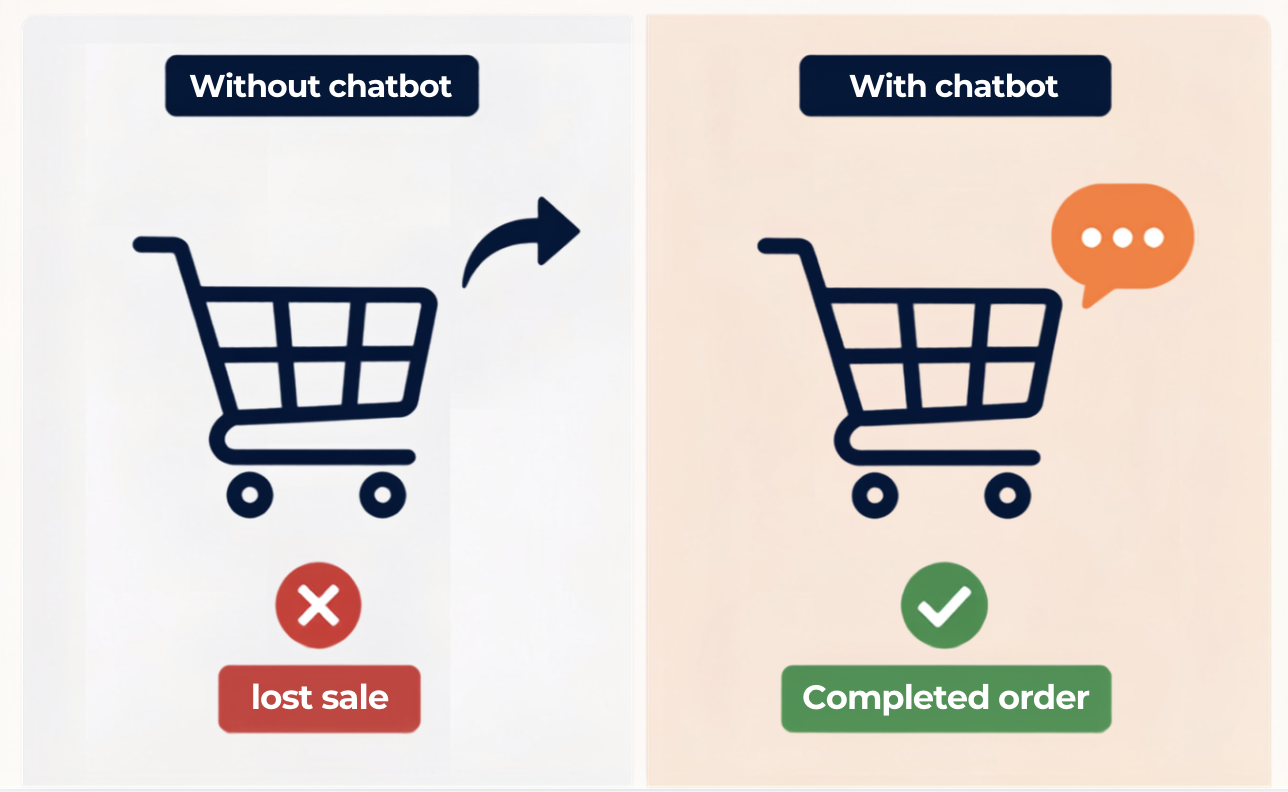
Cart abandonment sits at around 70% across ecommerce, according to the Baymard Institute. For a store doing $50,000 per month in revenue, that's roughly $115,000 in potential revenue leaving every month. Some of that is genuinely lost: price-sensitive browsers who were never going to buy. But a significant portion is recoverable: shoppers who added to cart, had a question, got distracted, or hesitated at the final step.
An AI chatbot recovery flow works through two channels. On-site, the chat widget fires proactively when a shopper with a full cart lingers on the checkout page without completing the order. The message references the specific product in their cart, offers a time-limited incentive if appropriate, and addresses the hesitation directly. Off-site, for shoppers who provided contact details, a WhatsApp or Messenger follow-up reaches them hours later with a personalised nudge.
The difference from a generic email sequence is specificity. A recovery message that names the exact product, references the shopper's size or selection, and creates a concrete reason to act right now outperforms "you left something behind" on every metric. Gartner research indicates that AI-powered cart recovery, when properly triggered with personalised messaging, recovers 10 to 20% of abandoned carts, compared to 2 to 3% for generic email sequences.
A fashion store with 4,000 monthly visitors and a 3.2% checkout conversion rate deploys cart recovery triggers. The chatbot fires when a shopper with a full cart stalls at checkout. Message: "Still thinking about those white trainers? They're running low in your size, and here's 10% off if you complete your order in the next 30 minutes." Cart recovery rate on triggered conversations: 18%. On a store doing $50k per month, recovering even a small fraction of those abandoned carts meaningfully shifts monthly revenue.
24/7 sales capture: Selling while you sleep
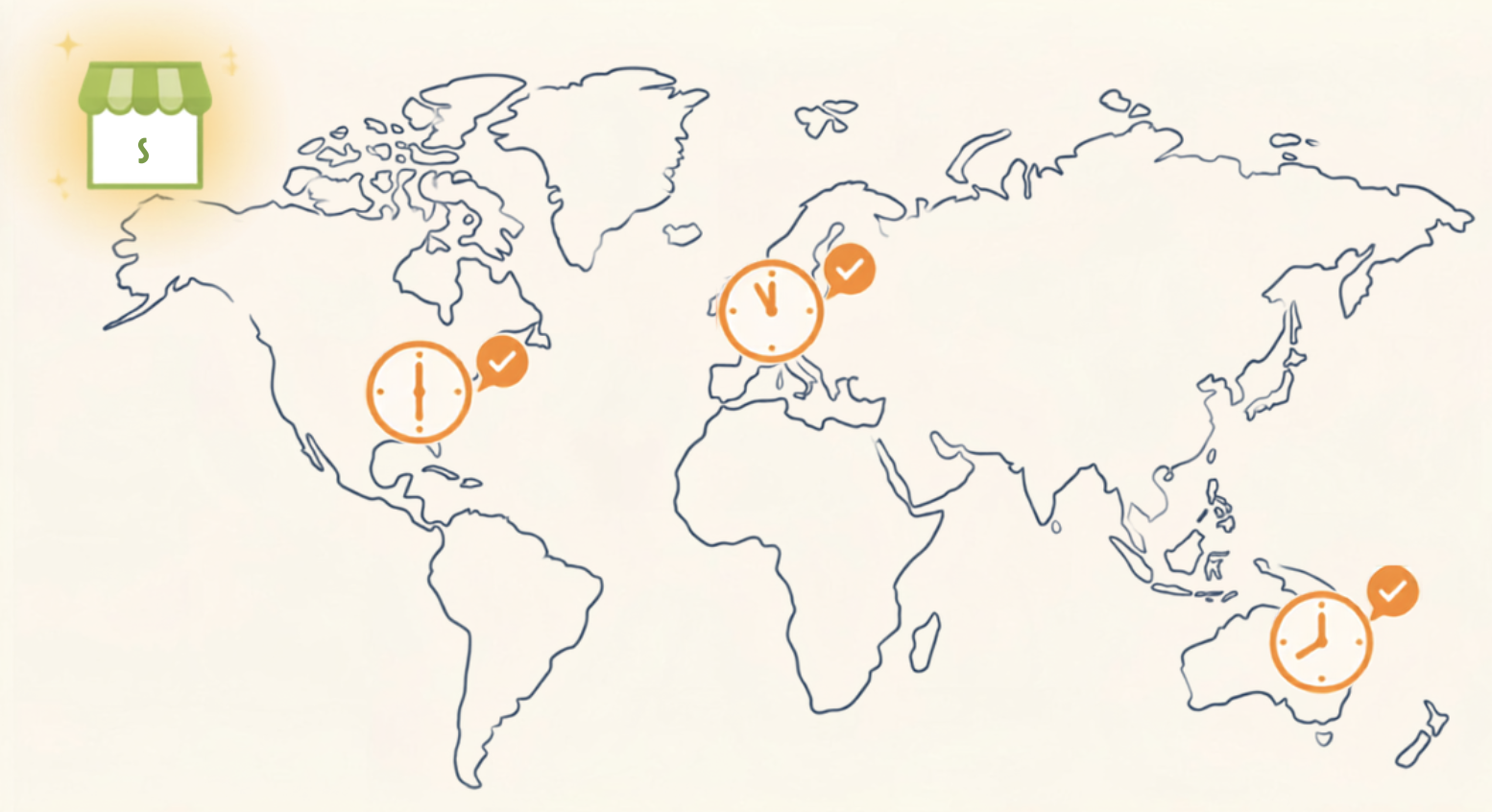
Most Shopify stores handle peak support volume between 9 AM and 6 PM in one time zone. But their customers shop globally and at any hour. A shopper in Sydney asking about sizing at 8 AM Australian Eastern time is reaching you at 10 PM your time. Without an AI chatbot, they get silence and they leave. With one, they get an instant answer and they check out.
This is one of the clearest direct revenue mechanisms available to ecommerce stores. Conversion rate drops sharply when shoppers have unanswered pre-purchase questions. A customer asking "does this come in a UK size 8?" at 11 PM either gets an instant answer and completes the purchase, or leaves and potentially buys from a competitor who does have someone available.
An ecommerce AI chatbot doesn't have office hours. It answers product questions, shipping queries, discount code questions, and return policy questions with the same accuracy at 2 AM as at 2 PM. For Shopify stores using Shopify Markets to sell globally, a chatbot trained on multiple shipping zones and currency questions removes a major pre-checkout friction point for international buyers.
A UK-based wellness brand selling to Australia notices significant traffic between 10 PM and 2 AM GMT (8 AM to noon AEST). Before their chatbot, those sessions converted at 0.8% because no one was online to answer questions. After deploying a Shopify-native AI chatbot trained on their product range and shipping zones, conversion rate during those hours climbs to 2.3%, matching their daytime performance. That improvement, across 30-plus days of overnight traffic, compounds into a meaningful monthly revenue lift.
Real-time checkout support: Removing the last barrier
The checkout page is where purchase intent is highest and where small frictions cause the most damage. Shoppers who have added to cart and navigated to checkout are already close to buying. What stops them is usually an unanswered question: about shipping cost, delivery time, return policy, or payment method. That question creates just enough doubt to cause them to close the tab.
Checkout support is distinct from cart recovery. Cart recovery catches shoppers after they've left. Checkout support catches hesitation before it turns into abandonment. When a shopper pauses at checkout for 30 to 60 seconds without completing, the chatbot opens proactively: "Any questions before you complete your order? I can help with shipping times, returns, or applying a discount code."
The most common checkout questions are answerable in one sentence. "Standard shipping to the UK takes 3 to 5 business days." "You can return any item within 30 days for a full refund." "Use code WELCOME10 for 10% off your first order." An AI chatbot delivers all of these instantly, removing the friction in the exact moment it occurs.
A skincare subscription brand finds in their Shopify analytics that 40% of checkout page visits don't complete. Their most common support ticket after checkout is "what's your return policy?" which means they're losing buyers who had that question but never asked it. They deploy a proactive chatbot trigger at checkout. The question gets answered before it becomes a lost sale. Checkout conversion rate improves by 12% in the first month. According to Hexagon's research on DTC brands using conversational AI, real-time checkout support can produce up to 25% conversion rate uplift in well-configured deployments.
Upsell and cross-sell: Revenue from every conversation
Every customer interaction is a potential upsell opportunity. An AI chatbot captures all of them. A human team captures a fraction.
The mechanism runs on two triggers: cart content and conversation context. Cart content triggers fire when the chatbot detects a product in the cart and surfaces a complementary item. Conversation context triggers fire when a shopper asks about a product, and the chatbot suggests a relevant addition before the main item has even been added.
Both are more precise than a static "customers also bought" widget, because they arrive during an active conversation where the shopper is engaged. A recommendation delivered mid-conversation, in context, with a reason to buy, outperforms a passive widget that sits unread on the product page.
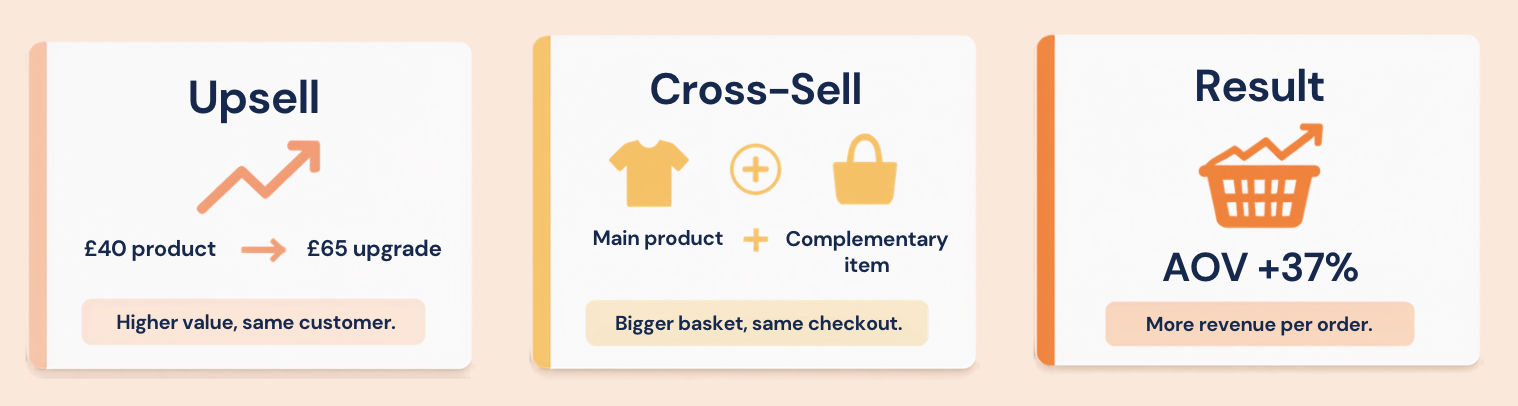
Upsell example: A shopper asks about a £40 moisturiser. The chatbot responds: "Most customers who buy this one upgrade to the 50ml version at £65. It lasts twice as long and comes with three free samples. Want to see it?" The shopper upgrades. That's £25 in incremental revenue from one conversation the shopper initiated themselves.
Cross-sell example: A shopper at a pet supplies store asks "do you have grain-free dog food for a labrador?" The chatbot recommends the food and adds: "A lot of labrador owners also grab the dental chew. It pairs well with grain-free diets and helps with plaque. Want me to add it?" The shopper says yes.
A pet supplies store trains its conversational AI chatbot for ecommerce to surface complementary products when a shopper asks about a product, before they've added anything to their cart. Average basket value on chatbot-assisted orders: £52. Average on unassisted orders: £38. That's a 37% AOV improvement driven entirely by well-timed cross-sell suggestions, at no additional acquisition cost. Timing is the variable most merchants underestimate. Our team has been building Shopify tools for over a decade, and when we built the upsell logic into MooseDesk, the biggest learning from early merchant setups wasn't about which products to recommend. It was about when. Upsell suggestions that fire the moment a shopper opens the chat get ignored. The same suggestion, delivered after the shopper has already asked a question and received a helpful answer, converts at a noticeably higher rate. The chatbot has earned a small amount of trust by that point. That trust is what makes the recommendation feel like a helpful nudge rather than a sales push.
What to measure: The numbers that confirm it's working
Watching total chat volume increase is not a sales metric. To confirm that chatbots for e-commerce sales are delivering real revenue, track these four numbers specifically.
- Chatbot-assisted conversion rate vs unassisted. Compare conversion rate for sessions where the chatbot was engaged versus sessions where it wasn't. If chatbot-assisted sessions convert at 3.8% and unassisted sessions convert at 2.1%, the chatbot is working. This is the single most direct measure of sales impact.
- AOV on chatbot-assisted transactions. If product recommendations and upsells are working, chatbot-assisted orders should show higher AOV than unassisted orders. Track this weekly. Flat AOV on chatbot sessions means the recommendation triggers need refinement.
- Cart recovery rate. Track the percentage of abandonment triggers that result in completed orders. A well-configured recovery flow should recover 10 to 20% of triggered conversations. Below 5% means the recovery message is too generic, too slow, or not offering the right incentive.
- Revenue attributed to chatbot touchpoints. Most Shopify analytics integrations or third-party attribution tools can track this if the chatbot is set up with conversion tracking. This is the headline number: what is the chatbot contributing to monthly revenue?
One nuance on attribution: a shopper who talked to the chatbot and also received an email reminder might convert from the email, but the chatbot gets attributed. Set up clean attribution windows before drawing conclusions in the first 30 to 60 days.
Most merchants see measurable chatbot-assisted revenue within four to six weeks of deployment, once the bot has been trained on real conversation data and initial recovery flows have been tuned from actual interactions.
Frequently Asked Questions about AI chatbots and ecommerce sales
How do AI chatbots increase ecommerce sales?
AI chatbots drive ecommerce sales through five mechanisms: product recommendations that guide undecided shoppers to the right purchase, cart abandonment recovery messages that bring back shoppers who left mid-checkout, 24/7 availability that captures international and late-night sales, real-time checkout support that answers last-moment questions before they become lost sales, and contextual upsell and cross-sell suggestions that increase average order value. Each mechanism is measurable and compounds with the others.
Do AI chatbots work for small Shopify stores?
Yes, and the ROI case is often stronger for smaller stores. A small store with one or two support staff gains proportionally more from chatbot automation than a larger team, because the chatbot handles high-volume routine queries so the team can focus on complex issues and customer relationships. The five sales mechanisms described in this article apply regardless of store size. Most Shopify-native chatbot apps offer free or low-cost tiers appropriate for stores early in their growth.
What is the best AI chatbot for ecommerce sales?
Look for a Shopify-native app that connects directly to your product catalog and order management system, handles both support and sales flows in one tool, and includes cart recovery triggers and proactive messaging. A chatbot that can't access your live product data can't make accurate recommendations. For a full comparison of options, see: Best AI Chatbot Apps for Shopify.
Can an AI chatbot replace a human sales team?
No, but it handles the volume work so your human team can focus on high-value interactions. AI chatbots are strong on product discovery, FAQ answers, checkout support, and cart recovery across all sessions simultaneously. Complex negotiations, bespoke orders, and high-value relationship management still need a person. The right model is human and chatbot working together: the chatbot handles 60 to 80% of incoming queries autonomously and escalates the rest with full context intact.
The five mechanisms in this article compound. A shopper who discovers a product through a recommendation, gets a cross-sell added to their basket, completes checkout after a proactive support message, and would have been caught by cart recovery if they'd hesitated. That's four automated revenue touchpoints in one session. None of them required a team member to be online.
MooseDesk is built specifically for Shopify: AI chat, live chat, and helpdesk in one app, connected directly to your product catalog and order data. Start driving sales from day one.
Try MooseDesk
AI chatbot, live chat, and helpdesk in one Shopify-native app.
Free plan available. 1-min setup. 24/7 Support.