
How AI chatbots work for ecommerce customer support
Table of contents
- How does a customer support chatbot work? (step by step)
- What makes it "AI"? NLP and Machine Learning in plain English
- How does it connect to your Shopify store?
- What does it do in practice? (3 examples)
- What AI chatbots can't do (And when you still need a human)
- Frequently Asked Questions about how AI chatbots work
When a customer types a message into the chat widget on your Shopify store, a customer support chatbot for ecommerce reads it, works out what they need, checks your store data, and sends a reply in under a second, without a human in the loop. The entire process runs on AI, but the mechanics behind it are simpler than most merchants expect.
If you're still fuzzy on the basics, start with our primer: What Is an AI Chatbot? This article goes one level deeper: how the technology actually works, how it connects to your Shopify store, what it does in practice, and where its limits are.
How does a customer support chatbot work? (step by step)
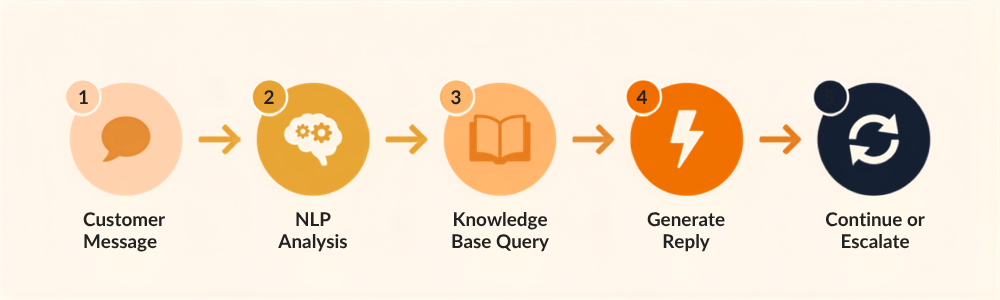
A customer support chatbot processes a customer message in five steps. The whole sequence takes under one second.
- The customer sends a message. Free text, any phrasing. "Is this waterproof?" "do u ship to canada lol" "my order hasnt arrived and its been 2 weeks". The chatbot handles all of it without needing tidy, formal language.
- Natural language processing (NLP) analyses the message. NLP is the technology that reads the intent behind a message rather than matching exact keywords. It identifies what the customer wants (the intent) and pulls out any specific details (a product name, an order number, a location) that the bot needs to give an accurate answer.
- The bot queries your knowledge base and store data. It searches your FAQs, product catalog, shipping rules, and return policies. For Shopify stores, this includes real-time order data when the chatbot connects to Shopify's API. That means it can tell a customer exactly where their order is, not just point them at a tracking email.
- It generates a reply and sends it. Modern AI chatbots don't pull from a pre-written script of canned responses. They generate a contextually appropriate answer in natural language. The reply fits the question, matches your store's tone, and lands in the chat window instantly.
- The conversation continues or escalates. If the follow-up question is still within scope, the bot handles it. If the customer is clearly upset, asks something outside the chatbot's training, or explicitly asks for a person, the bot hands off to a live agent, with the full conversation history intact, so the customer doesn't have to repeat themselves.
The speed and accuracy of this process is what separates a well-built AI chatbot from a basic FAQ widget. A FAQ widget shows a list. An AI chatbot has a conversation.
What makes it "AI"? NLP and Machine Learning in plain English
Two technologies do the heavy lifting. Understanding both takes about two minutes.
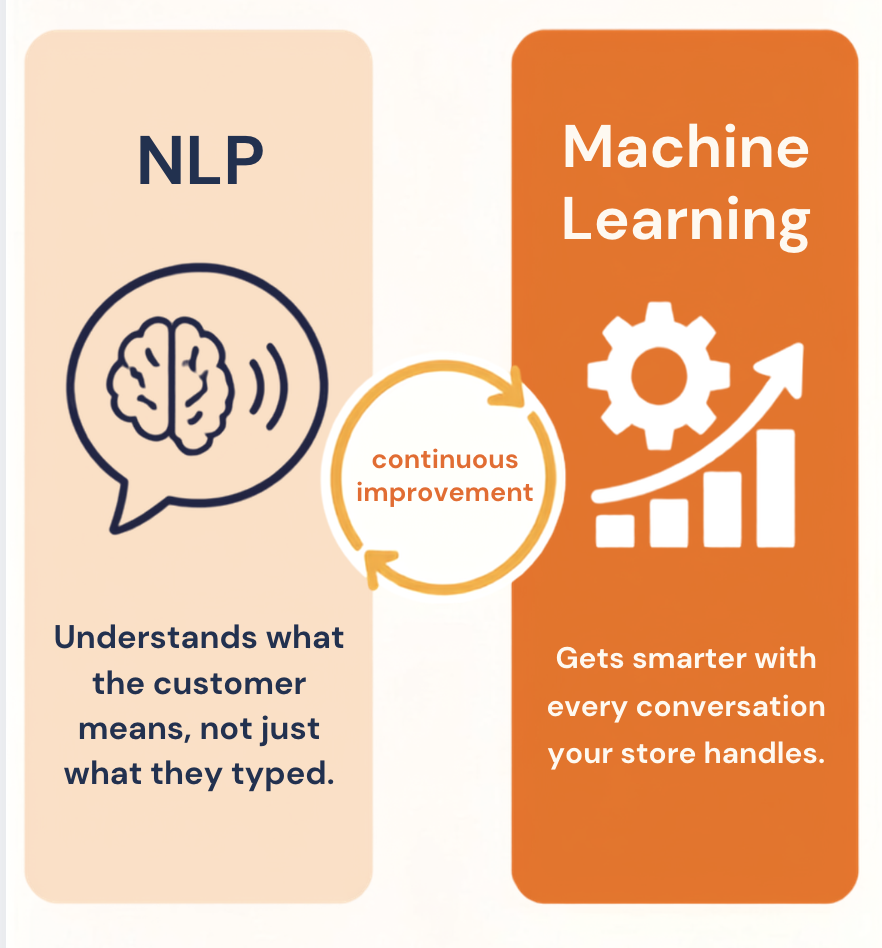
Natural language processing (NLP) is what lets the bot understand human language as it's actually written, not as a structured command. "I need to send this back," "how do I do a return," and "wrong size, want to exchange" are all the same request to an NLP-powered chatbot. It reads meaning, not phrasing.
Without NLP, you'd have a keyword-matching bot that breaks the moment a customer phrases something unexpectedly. With it, you have a bot that handles the real, messy variety of how your customers actually type.
Machine learning is what makes the bot improve over time. Every conversation it handles teaches it to recognise patterns, get better at edge cases, and generate more accurate responses for your store's specific questions. A chatbot that has processed six months of your customers' actual questions will outperform a freshly installed one, because the machine learning is specific to your store, not generic templates.
The most advanced chatbots run on large language models (LLMs), the same technology behind ChatGPT. This allows them to handle complex, multi-step conversations naturally. A merchant training their bot on three years of customer conversation logs and 500 product variants will have a chatbot that handles sizing edge cases and shipping questions far better than one running on out-of-the-box defaults.
How does it connect to your Shopify store?
This is the question no generic "how chatbots work" article answers. It's the one Shopify merchants most need answered.
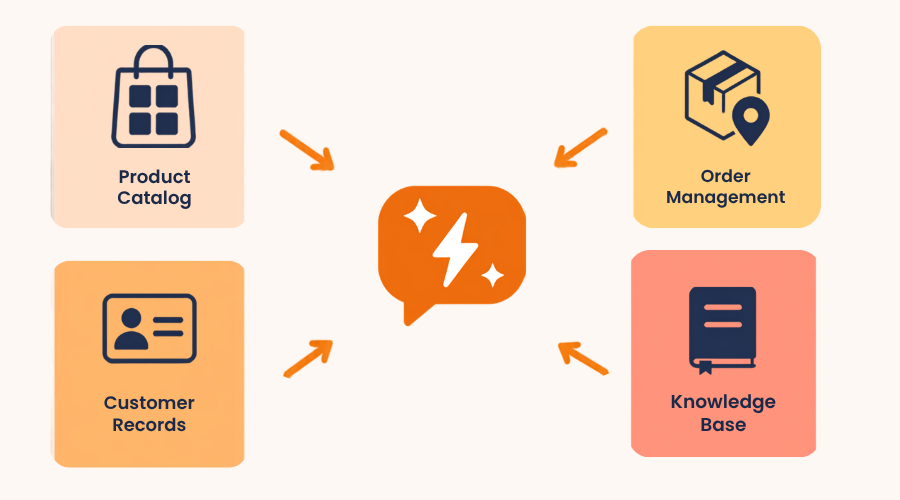
A Shopify-native AI chatbot connects to four data sources in your store:
Your product catalog. The bot can answer questions about specs, variants, stock levels, and pricing accurately because it has access to your actual product data, not a manually updated FAQ document that's three weeks behind.
Your order management system. "Where is my order?" is the most common customer service query in ecommerce, and it's also the most automatable. When your chatbot connects to Shopify's order data, it pulls real-time tracking information and answers the question instantly, with the specific details for that customer's order.
Your customer records. The bot can personalise responses: "Your last order was the navy hoodie in size M. Is that the one you're asking about?" That level of context makes the interaction feel like customer service, not a FAQ search.
Your knowledge base and store policies. Return windows, shipping zones, discount code rules, product care instructions: all of this lives in your knowledge base and the chatbot pulls from it accurately, every time.
Non-Shopify-native chatbots require third-party integrations to access this data. Shopify-native apps like MooseDesk connect directly through the Shopify API, which means the setup is faster, the data is always current, and you're not maintaining a separate sync. This distinction matters more than most merchants realise before they experience it firsthand. Our team has been building Shopify solutions for over 10 years, and MooseDesk launched in 2023 with native API access as a non-negotiable, not an add-on. The difference shows up most clearly in order tracking. A chatbot pulling live Shopify order data answers "where is my order?" correctly the first time. A chatbot syncing from a third-party connector answers with data that might be 15 minutes, an hour, or a day behind, which means telling a customer their order is processing when it already shipped, or worse, when it's already been delivered.
This is why a chatbot installed from the Shopify App Store typically outperforms a generic tool from day one. It starts with your store's actual data, not a blank slate.
What does it do in practice? (3 examples)
The technology makes more sense with real store scenarios.
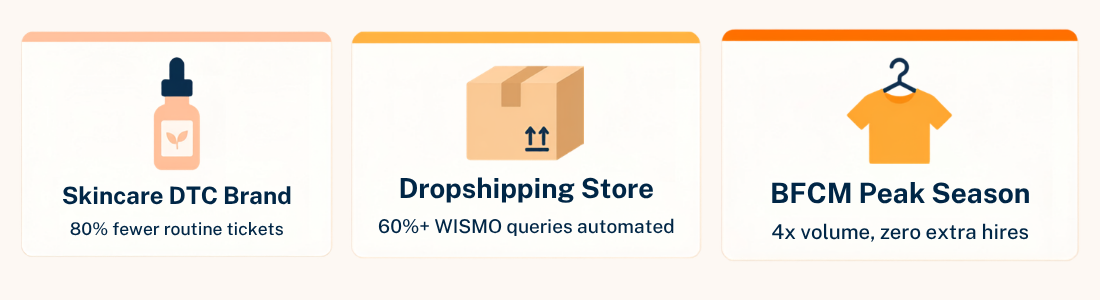
A skincare DTC brand. About 90% of their incoming support tickets are product questions: "Is this safe for sensitive skin?", "What's in this serum?", "Does this ship to the EU?". Their AI chatbot, trained on full ingredient lists, shipping zones, and certifications, answers all three instantly at any hour. Their support team now handles only complaints and complex exchanges, roughly 20% of the previous ticket volume.
A dropshipping store. Their biggest support drain is WISMO queries. "Where Is My Order?" is responsible for over 60% of their tickets. A chatbot connected to their Shopify order management system answers every tracking question automatically, with real shipment data for each customer's specific order. The founder stops spending Sunday nights clearing the support inbox.
A clothing store through BFCM. Support volume spikes 4x overnight. Sizing questions, return queries, discount code issues, and delivery estimates all hit at once. The chatbot handles all of it at scale without slowdown, without errors, and without a single seasonal hire. The human team focuses on the small percentage of complex disputes that genuinely need them.
Gartner projects that by 2029, AI will autonomously resolve 80% of common customer service issues without human involvement. For Shopify merchants, that transition is already underway. The stores seeing the earliest benefits are the ones with Shopify-native chatbots trained on their specific data, not generic tools deployed on default settings.
What AI chatbots can't do (And when you still need a human)
Honest answer: quite a lot. An AI chatbot is not a full replacement for your support team. Any tool that claims otherwise is overselling.
Chatbots are strong on high-volume, routine, predictable queries. They handle FAQs, order tracking, product questions, return initiation, and shipping queries reliably. That typically covers 60-80% of incoming support volume for most Shopify stores.
Where they still need human backup:
- Complex disputes requiring judgment: a customer claiming a product was damaged in transit and demanding a refund larger than your standard policy
- Emotionally charged situations where tone matters more than facts, and a real person is needed
- Edge cases outside the chatbot's training: unusual custom orders, rare shipping issues to specific regions, one-off exceptions to policy
- Anything requiring account-level decisions that need a human to authorise
The right setup is a bot that handles the high-volume routine queries and escalates the rest, with full conversation context passed to the agent so the customer never has to repeat themselves. A chatbot that knows its limits and escalates gracefully delivers a better customer experience than one that tries to handle everything and fails half of it.
Frequently Asked Questions about how AI chatbots work
How does an AI chatbot work? (Plain English)
An AI chatbot receives a customer message, uses natural language processing (NLP) to identify what the customer needs, queries your knowledge base or store data for a relevant answer, generates a natural-language reply, and sends it instantly. For Shopify stores, this includes pulling real-time order data and product information so the responses are accurate and store-specific rather than generic.
Is ChatGPT an AI chatbot?
Yes, ChatGPT is an AI chatbot, but a general-purpose one designed for broad conversational use across any topic. Ecommerce AI chatbots built for Shopify stores are purpose-built for customer service: they're trained specifically on your products, policies, and order data so they answer store-specific questions accurately. The underlying technology (LLMs) is similar, but the training and application are entirely different.
Do AI chatbots replace phone support?
No. AI chatbots handle text-based customer service queries automatically: FAQs, order tracking, return initiation, product questions. They don't replace phone support for customers who prefer voice, and they're not designed for emotionally complex situations or disputes requiring human judgment. Most Shopify stores use chatbots to reduce the volume of routine text queries while keeping human agents available for cases that genuinely need them.
What are the disadvantages of automated customer service?
The main limitations are handling complex disputes, managing emotionally charged conversations, and responding to edge cases the chatbot wasn't trained on. There's also a setup cost: a chatbot trained on thin or outdated information will frustrate customers rather than help them. The solution is a well-configured chatbot with a clean human handoff, not an attempt to automate everything.
Understanding how AI chatbots work is the first step. The second is finding one that's trained on your store's actual data from the moment you install it.
Want a chatbot that connects directly to your Shopify store data and starts answering customer questions from day one? MooseDesk is built for exactly this.
Try MooseDesk
AI chatbot, live chat, and helpdesk in one Shopify-native app.
Free plan available. 1-min setup. 24/7 Support.